
Union Budget 2026 – Overview and Analysis
The Union Budget 2026-27 was presented on Feb 1, 2026. Continued the government’s multi-year plan for growth-driven. by capital expenditure, fiscal responsibility, and structural reforms. It sets a spending target of ₹53.47 lakh crore, which is an increase of about 7.5% from the previous year. Capital investment is set at ₹12.22 lakh crore, reflecting a roughly 9% increase. Total non-debt receipts are estimated at ₹36.5 lakh crore. Which will finance a fiscal deficit of 4.3% of GDP, meeting the medium-term goal. Growth is expected to be strong, around 6.5% to 7%, while inflation. Which was under 3% in January 2026, remains low. Overall, Budget 2026 seeks to maintain India’s growth momentum through increased spending on infrastructure and technology while gradually reducing deficits.
Key highlights include significant increases in funding for education, health, and defence. There are new support funds for micro, small, and medium enterprises (MSMEs) and technology. As well as strong incentives to develop digital and green infrastructure. The Finance Minister emphasised the “Sabka Sath, Sabka Vikas” vision. With reforms like GST simplification and labour codes paired with investments focused on people. This summary presents the budget as balanced, combining growth stimulus in capital expenditure, manufacturing, and technology. With fiscal caution and targeted social measures. The chart below, taken from the budget “Key Features,” shows the main areas of expenditure and revenue.
Key Announcements and Policy Highlights
Capital Expenditure Surge
The capex for fiscal 2026–27 is ₹12.22 lakh crore, which is up about 9% from last year. With effective capital spending, including grants, of around ₹17.14 lakh crore. More than half of this funding goes to roads and railways.
Infrastructure Projects
Seven new high-speed rail corridors have been announced. Including routes like Mumbai–Pune and Hyderabad–Bengaluru. Along with a Dankuni–Surat freight corridor and 20 additional national waterways over five years. The budget for roads and highways increases to ₹3.10 lakh crore, up from ₹2.87 lakh crore.
Fiscal Targets
The fiscal deficit is set at 4.3% of GDP for 2026–27, down from 4.4% in 2025. Gross borrowings amount to ₹17.2 lakh crore, with net borrowings at ₹11.7 lakh crore to cover the gap. Debt-to-GDP is expected to decrease slightly to about 55.6%, with a medium-term goal of 50% by FY2030. The budget confirms a commitment to fiscal rules but approaches deficit reduction carefully, acknowledging growth needs.
| Fiscal Indicator | FY 2024-25 (Actual) | FY 2025-26 (RE) | FY 2026-27 (BE) |
| Fiscal Deficit (% of GDP) | 5.6% | 4.4% | 4.3% |
| Revenue Deficit (% of GDP) | 2.6% | 1.5% | 1.5% |
| Primary Deficit (% of GDP) | 2.4% | 0.8% | 0.7% |
| Nominal GDP Growth | 9.6% | 9.7% | 10.0% |
| Debt-to-GDP Ratio | 83.4% (General Govt) | 56.1% (Centre) | 55.6% (Centre) |
Tax and Tariff Changes
There are no changes in income tax rates or slabs. Key direct tax updates include extended deadlines for revised returns. The phased elimination of Minimum Alternate Tax (MAT) credits, a MAT rate cut to 14%. And higher thresholds for safe-harbour rules, such as for IT and GCC export units. For indirect taxes, significant reforms were made. The GST place-of-supply rule for “intermediary” services now follows the recipient’s location, making exports by Indian intermediaries zero-rated. Customs duties were adjusted, with many rates moving into the new tariff and exemptions being reduced. A notable 30-year tax holiday was announced for global cloud services. Providers that use Indian data centres, and safe-harbour margins for data services. Were relaxed. Excise-duty reliefs were extended to electric vehicle batteries and storage systems, including Battery Energy Storage and solar glass components.
Social Sector and Inclusion
Funding for health and education has increased significantly. The education budget, covering both school and higher education, totals ₹1.39 lakh crore, showing an 8.3% rise. New initiatives include setting up AVGC digital labs in 15,000 schools and 500 colleges. Creating university clusters near industrial corridors. And forming a committee to link education with industry and technology. The health allocation from the Ministry of Health and. Family Welfare is about ₹1.06 lakh crore which is a 10% increase. This funding supports the expanded Ayushman Bharat scheme. The National Health Mission has around ₹39,390 crore (up 6%). And new initiatives like the Biopharma “SHAKTI” program with ₹10,000 crore, five medical tourism hubs, and three new Ayurveda institutes.
Priority Sectors
A total of ₹1.63 lakh crore is set aside for agriculture and allied sectors, focusing on digital and value-chain support. This includes the “Bharat VISTAAR” platform and high-value plantation crops like coconut, cashew, and cocoa. MSMEs will benefit from a new ₹10,000 crore MSME Growth Fund aimed at creating “champion” enterprise. As well as improved credit access through the expansion of TReDS, professional help. And a ₹2,000 crore increase to the Self-Reliant India Fund for risk capital. The budget also boosts electronics and semiconductor manufacturing with ₹40,000 crore for components. And plans for new corridors and chemical parks for rare-earth and advanced manufacturing. Additionally, it allocates ₹22,000 crore to speed up residential rooftop solar projects. Doubles the PM-KUSUM solar irrigation fund to ₹50,000 crore. And introduces a ₹20,000 crore energy transition fund for carbon capture, utilisation, and storage (CCUS) and hydrogen.
Technology and Start-ups
The budget promotes a digital-first approach. It includes tax incentives for data centres and supports cloud. And AI infrastructure, fintech, and innovation, such as ₹5,000 crore for tech hubs in Tier 2 and Tier 3 cities. It aids the start-up ecosystem with easier compliance and extended filing deadlines. And “Corporate Mitras” for MSMEs, along with improved access to capital. Through the SME Fund and risk funds, and export incentives. Overall, there were no new funding announcements specifically for startups. But the integration of manufacturing initiatives, digital infrastructure. And improved business conditions aim to boost tech entrepreneurship.
Fiscal Deficit, Revenue and Expenditure Analysis
For FY2026-27, the Budget estimates are as follows: total receipts (excluding borrowings) are ₹36.5 lakh crore, and total expenditure is ₹53.5 lakh crore. This suggests revenue receipts of about ₹38.0 lakh crore and capital receipts (non-borrowing) of about ₹1.8 lakh crore. Capital outlay is ₹12.21 lakh crore, an increase from ₹11.21 lakh crore in BE 2025-26. When grants to states are included, the effective capital expenditure is ₹17.14 lakh crore, which is roughly 5% of GDP. Revenue expenditure is ₹41.26 lakh crore, which includes interest of about ₹14.04 lakh crore. This leads to a projected revenue deficit of ₹5.94 lakh crore, or approximately 1.6% of GDP. Consequently, the fiscal deficit is calculated as expenditure minus total receipts. Is expected to be ₹11.69 lakh crore, or 4.3% of GDP. Borrowing needs, which include market loans and small savings. Will cover this deficit, including net market borrowing of about ₹11.7 lakh crore.
Compared to last year, this shows continued consolidation; BE 2025-26 was 4.9% of GDP. While RE is 4.8%, the pace is slower to support growth. The debt-to-GDP ratio is predicted to decrease slightly, reaching approximately 55.6% as strong real GDP growth increases the denominator. Interest payments are still significant, around 4.8% of GDP, resulting in a much smaller primary deficit. Overall, revenue growth from tax collections is expected to rise by 7-8%. While non-tax and non-debt receipts will receive a boost from asset sales and profits. In summary, the fiscal situation is generally prudent. Expenditure is controlled, capital expenditure is prioritised, and deficits are gradually reduced, in line with the FRBM roadmap.
Tax Reforms (Direct and Indirect)
Direct Taxes
There were no changes to personal income tax slabs or rates; the standard and optional new regimes remain unchanged. To make compliance easier, the government gave three more years to revise tax returns and required professional bodies. Like ICAI, to create “para-professionals” (Corporate Mitras) to help MSMEs. A significant reform was the phasing out of MAT credits. Starting in April 2026, accumulated Minimum Alternate Tax credits will expire, ending the carry-forward provision. The MAT rate itself is reduced from 15% to 14% and will be a final levy. This means that companies switching to the new, lower tax regime won’t have to deal with old MAT credits.
The Buy-Back Tax was also revised, from FY2026-27. The buy-back of shares will be taxed as capital gains (22% for domestic holders, 30% for foreign ones). The budget stated that converting MAT would allow companies. To move to the new regime without the burden of legacy credits.
Indirect Taxes (GST, Customs, Excise)
A major change was aligning GST on intermediary services with the general “destination” principle. Indian intermediaries providing services to foreign clients will now be considered exports (zero-rated) rather than taxed at 18%. On the other hand, foreign intermediaries serving Indian clients will face GST through reverse charge. This change is expected to enhance India’s IT/ITeS competitiveness by eliminating previous distortions. Other GST modifications were mainly technical (place-of-supply, refund rules, input credits) and will require legislative changes (Finance Act 2026). Regarding customs duties, many rates have been moved into the official tariff schedule, making the structure simpler, and some exemptions have been reduced. Noteworthy reductions include the elimination of the basic customs duty on sodium antimonate (for solar glass) to promote solar manufacturing.
The EV sector also received indirect relief: battery import duties will stay low, and new exemptions for Battery Energy Storage Systems were introduced. Excise duty on petroleum and diesel remained mostly unchanged, while cess and surcharges on sin goods saw minor adjustments. In summary, the budget’s tax reforms focused on stability with strategic adjustments—no rate cuts for corporations or consumers, but efficiency improvements (GST fixes) and specific incentives (for technology, green initiatives, and exports) were prioritised.
Sector-wise Impact Analysis
Agriculture and Rural
The agriculture budget is ₹1.63 lakh crore (approximately $1.63 billion) with a roughly 7% increase. Funds are directed toward key programs like PM-Kisan, PM Awas Grameen, and MNREGA. New initiatives include the Bharat VISTAAR digital advisory platform, incentive schemes for high-value plantations such as coconut, cashew, cocoa, and sandalwood, and APMG’s Animal Husbandry Fund. The focus is on modernising and diversifying agriculture through technology, credit, and value-added exports. Critics have pointed out that there is limited attention to staple crops like fruits, vegetables, and spices, which make up about 33% of agricultural Gross Value Added (GVA). However, the budget allocates ₹9,967 crore for agricultural research and education and introduces seed and nutrition missions. Overall, analysts feel the policy direction favours high-tech farming and related sectors, which should eventually increase productivity and farm incomes.
Micro, Small & Medium Enterprises (MSMEs) and Industry
Budget 2026 continues to support MSMEs. A new MSME Growth Fund of ₹10,000 crore was introduced to support larger firms that help smaller ones in supply chains. Credit availability will improve as NBFCs can lend more to small businesses and invoice-trading platforms are expanded. Tax filing deadlines for MSMEs have been extended, and TDS for contractors has been simplified to reduce compliance burdens. An additional ₹2,000 crore will be added to the Self-Reliant India Fund for private equity investments in startups and MSMEs. These measures, along with ongoing programs, aim to ease liquidity issues and promote professionalisation. Experts observe a shift toward ecosystem-led industrial growth, especially with the emphasis on global value chains and the PLI for electronics worth ₹40,000 crore.
Infrastructure and Capital Goods
Investments in roads, rail, power, and urban infrastructure are prioritised. The capital expenditure (capex) is ₹12.2 lakh crore. Outlays for Roads and Highways increase to ₹3.10 lakh crore, including ₹1.87 lakh crore for NHAI. The Railways will receive funding for new corridors and modernisation. In energy, ₹22,000 crore is allocated for residential solar projects under PM-Surya Ghar, while ₹50,000 crore will go to solar pumps under PM-KUSUM to boost renewable capacity. The budget also funds transmission upgrades, with the Revamped Distribution Sector Scheme now at ₹18,000 crore. New corridors for rare-earth minerals in Odisha, Andhra Pradesh, Tamil Nadu, and Kerala were announced to secure supply chains for electric vehicles and wind energy.
Changes in tariffs, such as duty exemptions for battery storage systems and recycling of lithium-ion batteries, will help lower costs for green projects. Defense modernization is also part of this capital push. In summary, infrastructure spending is a key focus, strengthening connectivity and energy networks essential for long-term growth.
Education
The ministries of School and Higher Education are allocated about ₹1.39 lakh crore, reflecting an 8.3% increase. School education, including vocational and skill schools, receives about ₹83,562 crore, a rise of 6.3%, while higher education gets around ₹55,727 crore, an increase of 11.3%. Key initiatives include forming an Education-to-Employment committee to align curricula with AI and industry trends, establishing AVGC (Animation, VFX, Games & Comics) skill labs in 15,000 schools and 500 colleges, and creating five University/College Townships near industrial corridors to improve industry links. The budget also plans for new institutions, including an Indian Institute of Design in eastern India, upgrades for existing IITs and IIMs, and expanded STEM and innovation programs.
For students, the budget relaxes thresholds and TCS for the Liberalised Remittance Scheme, particularly reducing TCS on overseas education and medical remittances over ₹10 lakh from 5% to 2%, which lowers costs for studying abroad. The overall focus is on improving quality and aligning skills, although immediate physical infrastructure increases for schools and hostels were modest, existing digital and scholarship schemes will continue receiving support.
Health
The Ministry of Health and Family Welfare gets ₹1.06 lakh crore, a 10% increase, making up roughly 2% of the total budget. The National Health Mission is funded at about ₹39,390 crore, a rise of 6%. Key allocations include the Ayushman Bharat health insurance and the Pradhan Mantri Swasthya Suraksha Scheme. New initiatives include a ₹10,000 crore “Biopharma SHAKTI” program aimed at making India a hub for biologics and clinical trials, which will establish three new NIPER institutions. The budget also plans to create five integrated medical tourism hubs to attract foreign patients and establish three new All-India Institutes of Ayurveda.
To support the healthcare workforce, the budget includes training for 150,000 primary caregivers in geriatric and mental health care and allocates ₹1,000 crore to expand allied health professional colleges, which will add about 100,000 new professionals. Emergency care will be strengthened by requiring a 50% expansion of trauma facilities in district hospitals. Overall, public health programs see steady funding increases and a new focus on pharmaceutical innovation and medical infrastructure, which enhances India’s global role in health.
Defence
Defence spending rises sharply to ₹7.85 lakh crore, a 15.2% year-on-year increase, marking the largest ever allocation at about 14.7% of total government spending. The capital outlay for the Armed Forces is ₹2.19 lakh crore, increasing by 21.8%, which includes ₹1.85 lakh crore for new weapon acquisitions such as jets, UAVs, and ships. Notably, about 75% of the capital purchase budget will support the domestic industry, reinforcing the Aatmanirbhar Bharat goals. DRDO’s budget increases to ₹29,100 crore, with ₹17,250 crore allocated for capital expenditure.
The budget also boosts veterans’ welfare with ₹12,100 crore for the Ex-Servicemen Contributory Health Scheme, reflecting a 45% increase, and ₹1.71 lakh crore for defence pensions, which is a 6.6% rise. New measures to encourage domestic defence manufacturing include customs duty exemptions and support for clusters, reaffirming the commitment to “Make in India” in defence. Overall, the defence budget emphasizes modernization and research and development, with a focus on security and self-reliance.
Digital Economy and Startups
This Budget indicates a significant push for digital infrastructure. Finance Minister Sitharaman emphasised “data as capital” by proposing a 30-year tax holiday for non-Indian cloud providers that serve global customers from India, provided they also serve Indian customers through local resellers. Related-party data-centre services will benefit from a 15% “safe harbour” on transfer pricing costs. These measures aim to attract large-scale cloud investments and build AI compute capacity. Additionally, the budget expands the safe-harbour thresholds for IT/BPO exports from ₹300 crore to ₹2,000 crore with a margin of 15.5%, bringing more clarity for Global Capability Centres.
Funding for technology education, including AI labs in schools, semiconductor/PCB manufacturing, and fintech platforms, is confirmed. For startups, while no new fund has been announced, the overall environment improves through better infrastructure, improved ease of doing business, compliance relaxations, and expanded access to capital. Essentially, the focus on technology-driven sectors is supported by incentives and a robust ecosystem, aligning with the vision of a tech-led economy.
Impact on Middle Class, Businesses, and Investors
Middle Class
There was no reduction in personal income tax rates or new rebates, so salaried and household budgets did not get immediate tax relief. In fact, the increase in Securities Transaction Tax (STT) on derivatives (options and futures) slightly raised trading costs. On the positive side, some reliefs were targeted. Most notably, the reduction in TCS for overseas education and medical remittances (2% compared to 5% earlier) eases the burden on students and professionals. Subsidies for LPG, food, and fuel were maintained, and funding for schemes like PM-KISAN continued, providing indirect support to lower-middle families. Overall, critics say the Budget is not populist. It offers little direct consumer stimulus or significant tax cuts, so the immediate benefit to the average middle-class taxpayer is limited. The Finance Minister defends this by noting that high employment and inflation under 4% suggest the economy can sustain tax-neutral policies while driving growth.
Businesses and Industry
Generally positive but mixed. The capex boost and continuity of reforms were welcomed as pro-growth. Industry leaders noted the focus on supply chain through a “factory/cluster” approach and allowances for data-center and tech investments. Corporate tax rates remain unchanged at 22% without incentives, but MAT reforms cleared long-standing uncertainty for companies. The expansion of GST safe harbors and removal of tax ambiguity, particularly for IT services, received praise from IT and legal circles. On the downside, many hoped for broader corporate tax cuts or incentives; their absence, along with the new STT increase, disappointed some investors and trading firms. The auto sector appreciated EV battery duty exemptions, and green power companies welcomed renewable incentives. Overall, businesses view the Budget as neutral to positive for the medium term. It supports capacity expansion and ease of doing business while ignoring tax reductions.
Financial Markets & Investors
The immediate stock market response was volatile. On Budget Day (Feb 1), the Sensex/Nifty fell approximately 2%, marking the worst drop in six years, due to two surprises: the STT increase on derivatives and slightly larger-than-expected borrowings. However, analysts quickly labelled this a “knee-jerk” reaction. By the next trading session, markets rebounded, with Sensex gaining 1.17%, led by infrastructure heavyweights like Reliance and L&T. Fund managers noted that past experience shows marginal STT hikes seldom harm liquidity.
Ratings agencies maintained India’s stable outlook. Moody’s praised India’s forecast growth of 6.4% as the highest in the G20, while Fitch described the Budget as “broadly neutral” for growth, although it noted a slower path to fiscal consolidation. Bond markets remained calm as deficit targets are credible, with yields rising only slightly following the borrowing announcement. In summary, investors view the Budget as balanced; it supports long-term capex but lacks immediate returns, and markets largely overlooked short-term fluctuations.
Macroeconomic Implications
With real GDP growth expected to be around 6.5% to 7% for FY2026 to 2027, India ranks as one of the fastest-growing major economies. Major organisations such as the IMF and World Bank have praised India’s resilience. For instance, the RBI and economists anticipate growth close to 6.9% to 7%, fueled by domestic demand and investment, particularly in infrastructure and manufacturing. Inflation is likely to stay low, with the new CPI series showing January 2026 at just 2.75%, which is within the RBI’s 2% to 6% target. Food inflation dropped to approximately 2.1% due to normal monsoons and stable prices. This creates space for monetary easing, as the RBI cut rates sharply in late 2025. As a result, the budget’s expansionary approach can proceed without driving up inflation.
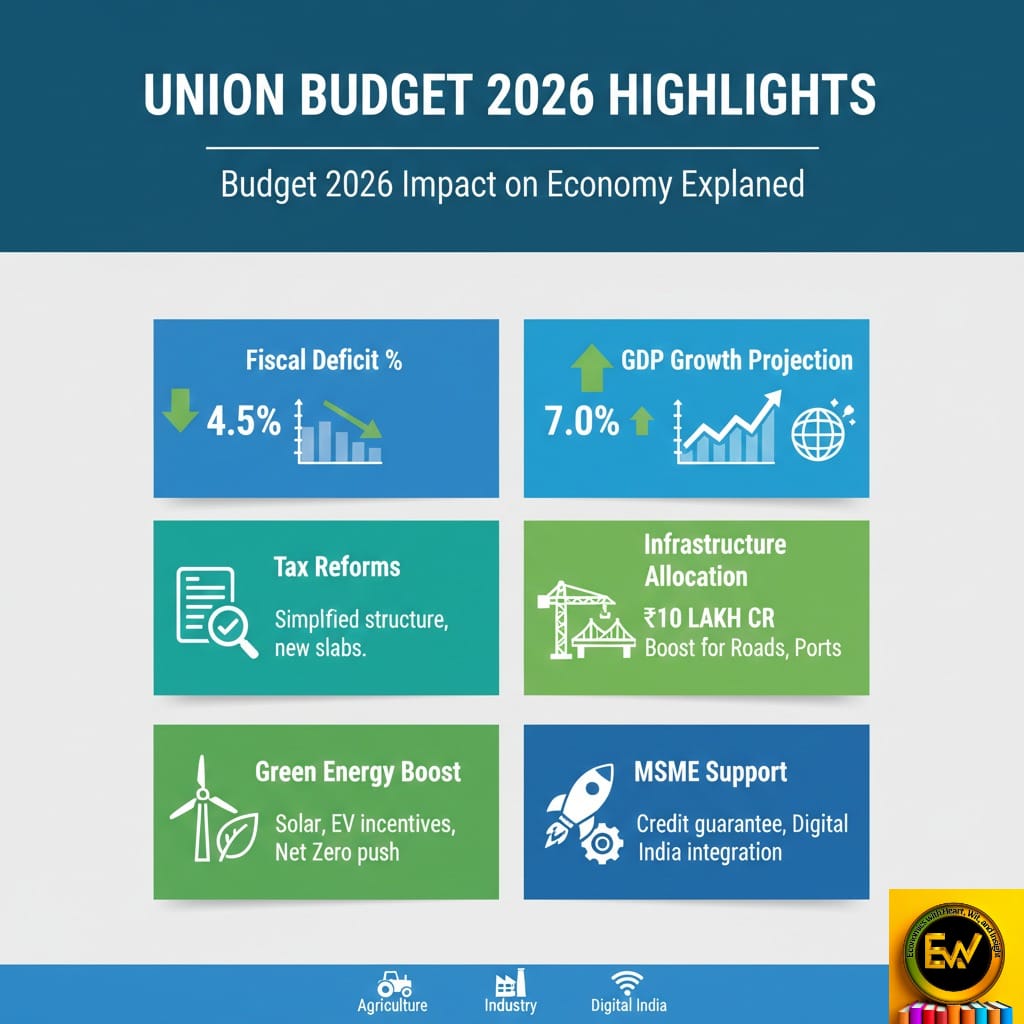
Regarding employment, increased capital spending and initiatives to boost manufacturing, such as the PLI programs, aim to generate more blue- and white-collar jobs, though it will take time to see tangible results. Consumer confidence is supported by rural assistance programs and steady jobs in IT and services, and unemployment, which is already low by historical standards, is not expected to rise.
In terms of investment, the budget’s stability and reforms. especially in digital and tech infrastructure, seek to attract both foreign and domestic capital. Ongoing bilateral trade talks with the US and EU and easier outsourcing through GST and data incentives. should help boost investment flows. Ratings agencies have maintained India’s credit rating. Moody’s has reaffirmed India’s strong growth outlook at 6.4% for FY27. while Fitch confirmed India’s BBB- rating, stating that the fiscal path is largely sustainable.
In summary, the budget promotes a positive macro cycle by funding growth industries while maintaining price stability. This should support continued GDP growth and bolster investor confidence.
Comparison with Budget 2025 and Past Trends
Union Budget 2026 continues the approach of recent budgets (2022–2025) with slight shifts in focus. The fiscal deficit is reduced to 4.3% for FY27 (from 4.4% revised in FY26), though consolidation has slowed as the government prioritises growth over sharp deficit cuts. Fitch expected 4.2% but accepted 4.3%. Capital expenditure remains a priority, rising to about 4.4% of GDP from 4.1%, showing renewed focus on infrastructure. Allocations for health, education, and agriculture remain broadly stable with modest increases.
| Category | Budget 2025-26 | Budget 2026-27 | Strategic Shift |
| Fiscal Deficit | 4.4% of GDP (RE) | 4.3% of GDP (BE) | Moderated consolidation for capex space |
| Capital Expenditure | ₹11.21 Lakh Crore | ₹12.22 Lakh Crore | Acceleration of physical backbone |
| Tax Philosophy | Standard Slab Adjustments | Income Tax Act, 2025 (Simplification) | From rate focus to administrative ease |
| Tech Focus | Digital Public Infrastructure | Agentic AI (Bharat-VISTAAR) | Precision AI and frontier tech leadership |
| Green Focus | Capacity Addition | CCUS & Battery Storage Piloting | Structural depth in decarbonization |
| MSME Approach | Credit Support | “Champion SME” Equity & Scaling | From survival to global competitiveness |
New features in 2026 include a strong push for green energy, with renewable subsidies and ₹20,000 crore for carbon capture, along with a more aggressive digital tech agenda that includes tax breaks for data centres and education in AI and AVGC. In contrast, Budget 2025 first introduced many production-linked incentive schemes and IT incentives; Budget 2026 mainly continues these policies.
The changes in the derivatives tax and the tax collection system in 2026 indicate a slight shift toward raising revenue after years of tax cuts and exemptions.
Overall,
Budget 2026 can be viewed as a combination of growth and capital expenditure consolidation from 2025. It increases total spending to ₹53.5 lakh compared to ₹50.65 lakh in last year’s budget estimate. It also maintains commitments to long-term goals such as debt and digitalisation, rather than making major shifts. Analysts point out that this year’s budget emphasises technology, sustainability, and export competitiveness more than previous budgets, which concentrated on hard infrastructure and boosting consumption.
Expert Opinions and Market Reactions
Ratings and Banks
Moody’s and SBI Research expect India to be the fastest-growing large economy next year. Moody’s January update raised India’s growth forecast for 2026/27 to 6.4%, citing strong fundamentals and reforms. SBI Policy predicts about 7% GDP growth in February 2026, mentioning that private capex is starting to increase after a slowdown. The RBI and IMF share this hopeful outlook. Regarding inflation, experts agree that the current low CPI inflation allows for a more relaxed approach.
Analysts and Think Tanks
Many commentators praised the focus on capital spending. For instance, one think-tank summary describes the budget as “forward-looking” and states it lays the groundwork in infrastructure, PLI, digital, and green sectors for India’s next growth phase. Industry leaders from IT and manufacturing generally welcomed the tech incentives and stability in tax policy. However, civil society pointed out the lack of immediate relief for low-income groups. Think-tank analyses mention that maintaining the deficit target slightly above 4% allows room for further reform if necessary.
Markets
As mentioned, stock markets initially reacted negatively due to concerns over the derivatives STT hike and funding issues, but quickly recovered. In terms of sector movements, infrastructure and capital goods stocks surged due to the capex boost, while brokerage and hedge-fund firms expressed unease about the STT. Global investors saw the budget as balanced, and foreign inflows into equities dropped only briefly. Bond yields saw slight increases following the borrowing announcement, but stayed stable thanks to central bank and RBI purchases. Overall, market experts described the reaction as “tepid,” with fundamentals such as growth and earnings ultimately influencing prices.
Strengths, Limitations, and Critical Evaluation
Strengths
The budget’s biggest strength is its consistency and trust. By sticking to fiscal targets of 4.3% and increasing capital expenditure to ₹12.2 lakh, it follows the path of infrastructure-led growth that has been prioritised since 2021. The significant funds for healthcare, education, and rural programs ensure that social goals are not overlooked. Supply-side reforms such as GST adjustments and simpler compliance, along with the support for domestic manufacturing through the Production-Linked Incentive scheme and raw material duty cuts, improve long-term competitiveness. The budget also effectively addresses new areas like climate and green energy with funding for renewables and incentives for carbon capture, as well as technology with investments in data centres and AI training, positioning India for future global trends. Many experts observe that by not using reserves to reduce personal taxes, the government maintains space for growth investment.
Limitations
Critics argue that the budget lacks short-term stimulus or redistribution. The middle class and poor received no new direct benefits, such as an increase in the income tax exemption or new cash transfers. The choice to slow fiscal consolidation, with a 4.3% target instead of the planned 4%, may concern fiscal conservatives. Some industry groups were hoping for deeper cuts in corporate taxes or tariffs, and their absence disappointed them. On the international front, the modest reduction in the headline deficit and the high borrowing of ₹17.2 lakh may raise concerns about debt sustainability, though it remains within targets. The dependence on sustained high GDP growth to meet targets poses a risk if the economy slows.
Critical Perspectives
From a balancing view, many see the budget as “supportive of growth” according to agencies like Fitch, as it avoids austerity and invests in productive capacity. It receives praise for discipline, maintaining the deficit below 4.5%, and for transparency with the new Income Tax Act and streamlined offences. However, consumer groups express disappointment over the absence of relief from GST or lower petrol and diesel prices. Critics from the opposition feel it favours corporations over households. Economists point out that several major reforms, such as a new tax code and privatisations, have been “announced” but not fully explained; implementation will be crucial. Overall, the budget gets mixed but measured reviews, appreciated for its long-term vision while facing scrutiny over immediate benefits.
Long-term Structural Impact on the Economy
Budget 2026 focuses on building capital, advancing technology, and fostering self-reliance to boost India’s long-term growth. Ongoing investments in highways, railways, waterways, and power distribution aim to cut logistics costs, alleviate supply issues, and improve rural access. By supporting sectors like semiconductors, electronics, pharmaceuticals, and defence manufacturing, along with selective import duty protection, the budget aims to strengthen the domestic industrial landscape and encourage higher value production.
Green energy efforts, such as expanding solar energy, energy storage, hydrogen, and carbon capture. are expected to lower emissions and create new economic opportunities. A greater emphasis on digital infrastructure, including data centres and cloud services. may help position India as a global hub for research and development and AI-driven industries. Education reforms, AI labs, vocational training, and healthcare improvements are designed to build human capital and enhance labour productivity.
However, the long-term effects depend on effective execution. Meeting the 50% debt-to-GDP goal by 2030 is difficult but could free up funds for growth-focused spending. Tax reforms aim to make compliance easier and improve the business climate. While anti-poverty programs continue, the budget mainly relies on growth-led inclusion instead of strong redistributive measures.
Conclusion: Growth-Oriented, Inclusive, or Reform-Driven?
Budget 2026 focuses on growth and reform while including some selective elements. It strongly supports growth. Capital spending is at record levels, and policies aim to boost manufacturing, infrastructure, and the digital economy. Structural reforms such as digitalisation, taxation, and deregulation take centre stage as part of a long-term strategy. The budget is moderately inclusive since it maintains or slightly increases. spending on health, education, and rural programs to assist farmers and students. However, it avoids populist fiscal handouts or consumption subsidies. Essentially, the budget shows that the government prioritises expanding the economy through investment and competitiveness. Instead of further dividing it with handouts. This balance of keeping deficits near target while promoting investment in future sectors. Has been recognised by agencies like Moody’s and Fitch as favourable for sustained growth.
In the short term, the impact will be seen in industries focused on infrastructure and technology. Long run, the combined effects of higher capital expenditure, human capital development, and improvements. In the ease of doing business should strengthen India’s growth and reduce structural barriers. Whether these benefits will happen depends on execution and global conditions. On paper, Budget 2026 clearly states the intent to advance India’s economy. Through investment, innovation, and reform, while also maintaining fiscal responsibility.