
India’s Youth Unemployment Crisis

Introduction
Untapped Potential vs. Alarming Reality. India now has the world’s largest youth population, with an estimated 371 million people aged 15 to 29, accounting for 27% of the country’s population. In theory, this “demographic dividend” could greatly boost growth. In reality, however, a shocking number of young people are jobless. The International Labour Organisation notes that youth unemployment has increased in recent decades, rising from about 5.6% in 2000 to nearly 18% by 2018, even as overall national unemployment remains low at around 5%. With roughly one in six young Indians unemployed, experts warn that India’s growing workforce may turn into a demographic disaster instead of an advantage. This hidden crisis of millions of educated youths without work threatens India’s economic growth, social stability, and global competitiveness.
Magnitude of the Crisis – A Tale of Two Rates
The gap between youth and overall unemployment is striking. Official data reveal that India’s unemployment rate for all ages is about 5.2%. In comparison, the unemployment rate for youth aged 15 to 29 is nearly three times that. For instance, by mid-2025, urban youth unemployment was approximately 19.0%, while in rural areas, it was around 13.0%—significantly higher than the national average. This indicates that roughly 16% of all young Indians are unemployed, compared to about 5% for older workers. Policymakers now warn that one in five young people in cities has no job. This situation is shifting what was once seen as a demographic advantage into a burden.
- Youth unemployment (2024): ~16.0% (vs. 5.2% overall).
- Urban vs. Rural: Urban youth ~19%; rural youth ~13%.
- Education level: Surprisingly, higher education equals higher joblessness (see below).
These figures highlight the extent of the crisis. Millions of graduates and school-leavers cannot find work, which threatens India’s growth. Economist Raghuram Rajan warned that this underemployment could hinder India’s growth and stability.
Trends & Patterns (2018–2024) – Troubling Persistence
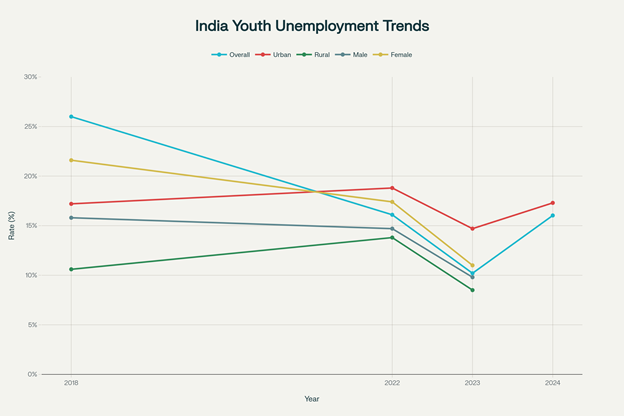
Unlike the national rate, which has gone down, youth unemployment has hardly changed in recent years. By the 2023-24 PLFS round, youth joblessness was around 10-12% nationwide, which is still double or more than the overall rate. In some areas, it even spiked. Long-term ILO data show that the youth rate rose sharply from about 5.6% in 2000 to about 6.2% in 2012. It then jumped to around 18% by 2018 before easing to about 15% in 2020. This means India’s youth unemployment rate is much higher than the global average, even in advanced economies. In the US and EU, youth rates are generally in the mid-teens or lower, thanks to stronger social support systems.
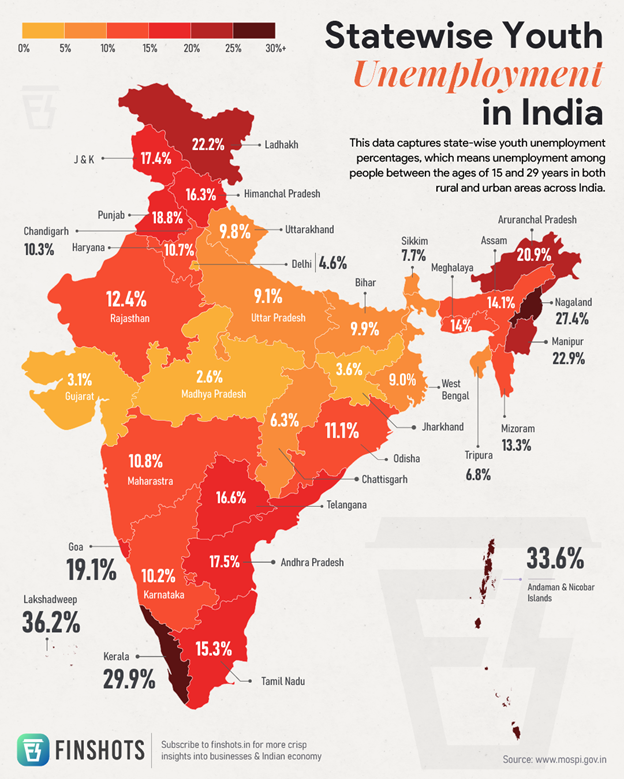
State differences show the crisis is uneven. For example, PLFS 2023-24 data finds that Lakshadweep (36.2%), Andaman & Nicobar (33.6%), Kerala (29.9%), and Nagaland (27.4%) have the highest youth unemployment rates. In contrast, Madhya Pradesh (2.6%), Gujarat (3.1%), Jharkhand (3.6%), and Tripura (6.8%) have much lower rates. Generally, more industrialised, rural, or agriculture-based states like Gujarat and Madhya Pradesh have significantly less youth joblessness compared to highly urbanised or literacy-focused states such as Kerala, Goa, and Punjab.
Education–Employment Paradox – The Inverted Pyramid
One of the most counterintuitive aspects of India’s crisis is that more education often means higher unemployment. Recent ILO estimates show:
- Illiterate youth: ~3.4% jobless.
- Secondary education or higher: ~18.4% unemployment.
- College graduates: ~29.1% unemployed.
- Postgraduates: even higher in many cases.
Graduates are nine times more likely to be jobless than their illiterate peers. The qualification-job mismatch is shocking. According to the Economic Survey 2024-25, only 8.25% of graduates have jobs that match their qualifications. More than half of India’s graduates and 44% of postgraduates end up in low-skill jobs that do not match their education. This highlights a huge skills gap. India produces millions of graduates each year, including over 2 million engineers, but it does not create enough skilled jobs. The ILO states that the Indian economy has not created enough good jobs in non-farm sectors for educated youth. As a result, highly educated young people suffer from underemployment or remain at home, unable to start their careers.
The NEET Crisis – A Hidden Emergency.
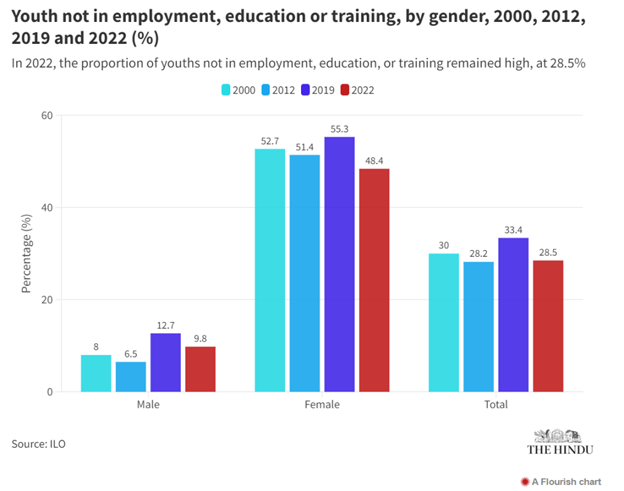
Not all jobless youth are actively searching for work. India also faces a significant NEET (Not in Education, Employment, or Training) issue: those who are neither working nor studying. Astonishingly, about 103.4 million Indian youth, or 27.8% of all 15–29 year-olds, are NEET as of 2022. This figure is far above the global average of around 22%. In fact, roughly 1 in 3 young Indians falls into the NEET category. Most of these individuals are not unemployed by choice. Instead, they are out of the labour force, often due to a lack of opportunities, skills mismatch, or family responsibilities.
The gender gap in NEET is serious. Women make up 84.9 million of the NEET youth, which is 82.1% of the total NEET population. In contrast, there are only 18.5 million men in this category. This means that 48.4% of young women are NEET, while just 9.8% of young men are NEET. In other words, Indian girls are nearly five times more likely to be NEET than boys. Most NEET women are at home, which shows the impact of social limitations and very low female workforce participation. Research indicates that this disadvantage for women in NEET has continued or even increased over time. This situation results in a waste of half the youth workforce and raises significant equity issues.
Regional & Gender Disparities.
Beyond NEET, looking at unemployment reveals significant gender and regional differences. South and island UTs, such as Kerala, Lakshadweep, and Andaman & Nicobar Islands, have the highest joblessness rates. Gender disparity is evident. Nationally, female youth unemployment is around 21.6%, which is much higher than male unemployment at about 15.8%. In urban areas, the situation is even worse. Approximately 20.1% of young women are unemployed, compared to just 8.2% of rural women. Urban young men do better, with about 17.2% jobless, but this rate is still higher than that of rural men, which is around 10.6%. In summary, young urban women are the most affected; they experience an unemployment rate nearly three times that of rural women.
| Level of Education | Unemployment Rate – Male (%) | Unemployment Rate – Female (%) | Unemployment Rate – Total (%) | Unemployment Rate Ratio (Graduate vs. Illiterate) |
| Cannot Read/Write | – | – | 3.4 | 1.0x |
| Secondary or Higher | 17.5 | 21.4 | 18.4 | 5.4x |
| Graduate | 26.4 | 34.5 | 29.1 | 8.6x |
| Source: ILO / IHD India Employment Report 2024 |
These gaps show a “double disadvantage.” Young women in India face both a general shortage of jobs for youth and strong gender barriers. Analysts point out that this contributes to India’s very low female labour participation, which is around 25%. It also leads to a possible “lost generation” of women. For instance, Kerala, the most literate state in the country, has about 29.9% youth joblessness, with female unemployment at around 47.1% among young people.
Economic & Social Consequences – Heavy Toll
The impact of youth unemployment goes beyond just frustrated graduates. Each year, hundreds of thousands of skilled young workers remain underused, which lowers GDP and productivity. Estimates show that India loses significant potential output, about the same level of productivity as entire advanced economies, by failing to employ its youth. Unemployed young people spend less money, which hurts domestic consumption and tax revenues. Over time, long periods of unemployment can “scar” workers by damaging their skills and reducing their lifetime earnings. A large population of NEET individuals leads to weaker human capital and less innovation. One study indicates that India’s share of GDP from manufacturing has stagnated despite the Make in India initiative, putting the promise of a ‘demographic dividend’ at risk.
Socially, idle youth contribute to distress. Studies show mental health impacts. In one survey of jobless youths, 54% reported significant depression and 62% reported high anxiety. Unemployment delays life milestones, such as marriage and starting a family, and can put a strain on families. Despair can also lead to unrest. Violent protests, like those against the Agnipath military recruitment scheme from 2022 to 2023, were largely driven by frustrated unemployed young men. As media analysis pointed out, “youngsters protest about the lack of good jobs.” The Agnipath demonstrations became a sign of the larger youth job crisis. In short, this crisis threatens not only incomes but also India’s social fabric and stability.
An International Perspective:
Benchmarking India’s Challenge Comparing India’s situation with other major economies shows the scale and uniqueness of its challenge.
India vs. China:
The contrast with China is particularly revealing. China effectively used its demographic advantage to drive a manufacturing-led economic boom. It became the “world’s factory” and lifted hundreds of millions out of poverty by tapping into its large surplus labour for labour-intensive industries. India has not managed to replicate this model. Its ‘Make in India’ initiative has not sparked a manufacturing surge. Currently, its policy focus on capital-intensive sectors like electronics does not match its demographic reality of a large, low-skilled workforce. While China is now facing youth unemployment issues, with rates recently reaching a record 21.3%, this is after decades of successful industrialisation. India faces a similar crisis without having first built the industrial base to support its population.
India vs. Developed Economies (US & EU):
In terms of raw numbers, India’s youth unemployment rate is 16% according to the World Bank/ILO measure. This is significantly higher than the United States, which is at 9.39% in 2024, and is on par with or slightly above the rate in the European Union, which is 14.4% in July 2025. However, this comparison can be misleading because it overlooks a significant difference: the availability of social safety nets. In the US and EU, unemployed youth can access unemployment benefits, job placement services, and other forms of social security that provide essential support during economic hardship. In India, such formal safety nets are nearly non-existent for most people. Unemployment insurance covers only a small portion of the workforce.
This lack of a safety net results in a much higher human cost of unemployment in India. It leads to more severe poverty, increased mental health issues, and a greater chance of social unrest. India finds itself in a “worst of both worlds” situation. It struggles with developing-world levels of job scarcity and informality while its youth unemployment rates approach those of developed countries, all without the systems in place to address the social consequences.
The rate of youth Not in Education, Employment, or Training (NEET) highlights India’s precarious position. In 2022, India’s youth NEET rate was a concerning 28.5%, well above the global average of 21.7%. This suggests a much deeper issue of youth disengagement and exclusion from the economy compared to many other regions.
| Country/Region | Youth Unemployment Rate (%) (15-24) | Youth LFPR (%) | NEET Rate (%) | Presence of Robust Social Safety Net for Unemployed |
| India | 16.03 | 46.5 (15-29) | 28.5 (2022) | Limited |
| China | 17.8 (July 2025) | – | 21.3 (June 2023) | Limited |
| USA | 9.39 | 59.5 (July 2025) | – | Yes |
| European Union | 14.4 (July 2025) | – | – | Yes |
| World Average | 13.57 | – | 21.7 (2023) | Varies |
| Note: LFPR and NEET data may have different age ranges or reference years as indicated. |
Root Causes – Why the Crisis Persists
Several structural factors underlie this quagmire:
- Jobless growth: India’s economy has grown, but has not created enough jobs. Manufacturing and formal services have not been able to take in millions of new workers. For example, “Make in India” has not raised manufacturing’s GDP share in ten years and has not delivered the promised 100 million jobs. Much of the recent growth has been in sectors that use a lot of capital, like finance and IT, which employ relatively few people.
- Skills mismatch: There is a significant gap between the skills young people gain and those that employers need. While universities produce graduates, many of them lack practical or industry-related training. The ILO points out that India has not created enough well-paying jobs in non-farm sectors for educated youth. As mentioned earlier, only 8% of graduates have jobs that match their training. This is a clear sign of a mismatch.
- Informality and underemployment: Much of India’s workforce is in the informal sector or self-employment. Official surveys may consider someone working just an hour a week as “employed,” which hides disguised unemployment. In reality, many young people struggle to get by with temporary jobs like casual labour or family farms without full-time work. Therefore, the labour market seems to create jobs, but most of these positions are low-quality or part-time.
- Demographic pressures: India adds 7 to 8 million young people to the labour force every year. Meeting this demand needs millions of jobs annually, which is much more than what is currently being created. Without significant new opportunities, each year’s group will increase the number of unemployed.
Policy Efforts & Gaps – Progress, but Not Enough
The government has launched many initiatives to tackle youth jobs, but results have been mixed:
- Skill India / PMKVY: The flagship skilling program has trained over 16 million youth since 2015. However, placement rates are poor. One report found that only about 15% of trainees found jobs. This raises concerns about the quality of training and its connection to employment opportunities.
- Startup India: The entrepreneurship push claims to have spurred a boom. DPIIT reports 1.59 lakh startups recognised, generating 16.6 lakh jobs from 2016 to 2024. This is promising, but the total numbers (approximately 166,000 per year) still fall well short of the millions needed. Moreover, many jobs in startups are concentrated in a few tech hubs, leaving other areas untouched.
- Make in India: Despite its lofty goals, manufacturing’s potential has mostly not been fulfilled. India’s manufacturing share remained about 17% of GDP from 2014 to 2023, showing little evidence of the significant new jobs that were expected. Poor execution, such as high tariffs and red tape, along with a focus on temporary incentives like PLI schemes, has limited growth.
- Other schemes: Various programs like MGNREGA (rural jobs) and rural employment guarantees help to some extent, but they don’t meet the needs of skilled youth in urban areas. Overall, experts point out a consistent gap in implementation. Policies may be on paper, but coordination, funding, and attention to actual results have fallen short.
In short, while the government has used education and business tools, most indicators, like youth unemployment and the NEET share, have hardly changed. Training programs fall short, and entrepreneurship has not grown enough to address demographic challenges. Policymakers admit that jobs remain the “Achilles heel” of India’s growth story.
The Way Forward – Urgent Reforms Needed
Addressing this time bomb requires a comprehensive, coordinated strategy:
- Align education with industry: Revise curricula and skill training to meet real labour-market needs. Increase vocational training, particularly in rural areas, and support “sector skill councils” that create industry-specific programs. Promote apprenticeships and on-the-job training that connect to jobs, not just classroom learning.
- Invest in labour-intensive sectors: Stimulate sectors that have historically employed many young people, such as textiles, tourism, construction, food processing, and light manufacturing. Offer targeted incentives, like land, credit, and technology, in struggling regions to attract businesses. Increase support for Micro, Small, and Medium Enterprises (MSMEs), since they provide most jobs, by making financing easier, cutting compliance requirements, and establishing industrial clusters.
- Boost entrepreneurship and MSMEs: Deepen startup support beyond large cities. Improve the ecosystem, including funding, incubators, and market access, for rural and small-town entrepreneurs. Simplify regulations for small businesses and support local enterprises, such as rural handicrafts and agro-processing, that can provide jobs for young people at scale.
- Promote women’s workforce participation: Address non-economic barriers. Expand safe mobility, childcare services, flexible work options, and female-friendly skilling programs. Strengthen women’s entrepreneurship schemes. Since nearly half of young women are NEET, even small increases in female labour force participation could significantly reduce the overall unemployment burden.
- Unemployment support and mental health: Pilot an unemployment insurance or guaranteed minimum income program for unemployed youth to create a safety net. At the same time, expand counselling and mental health services for unemployed and NEET youth, building on programs like the ANWESHA helpline, to reduce the personal impact of joblessness.
- Regional job plans: Tailor strategies to state contexts. Urban states require more manufacturing and service jobs. Rural and agriculture-dependent states need support for agro-industry and rural businesses. Involve state governments and local stakeholders in developing specific job missions.
- Data and monitoring: Improve labour market data. Speed up and provide more detailed information from the PLFS to track progress. Use data to find emerging skill gaps and groups of unemployed people in real time. Monitor the results of programs by comparing placements to targets. This helps refine the programs.
Conclusion – A National Emergency
India is at a crucial moment. Its youth have the potential to spark a new era of prosperity if the economy can create jobs that meet their needs. If not, this large generation risks becoming a long-term burden. Policymakers now label youth unemployment as a national emergency, similar to a hidden crisis. The good news is that strong reforms can still take advantage of India’s demographic benefit. By quickly increasing job opportunities, closing the skills gap, and including young adults in the workforce, India can make a positive change. As one think tank warns, without action, the benefit could easily turn into a disaster. However, with bold policies, India’s youth can drive the next wave of growth.
How the 2026 Iran Conflict Could Reshape India’s Inflation, Energy Security and Growth
The March 2026 U.S.-Israel air strikes against Iran have sparked a broader Middle East war…

Union Budget 2026 – Overview and Analysis
The Union Budget 2026-27 was presented on Feb 1, 2026. Continued the government’s multi-year plan…
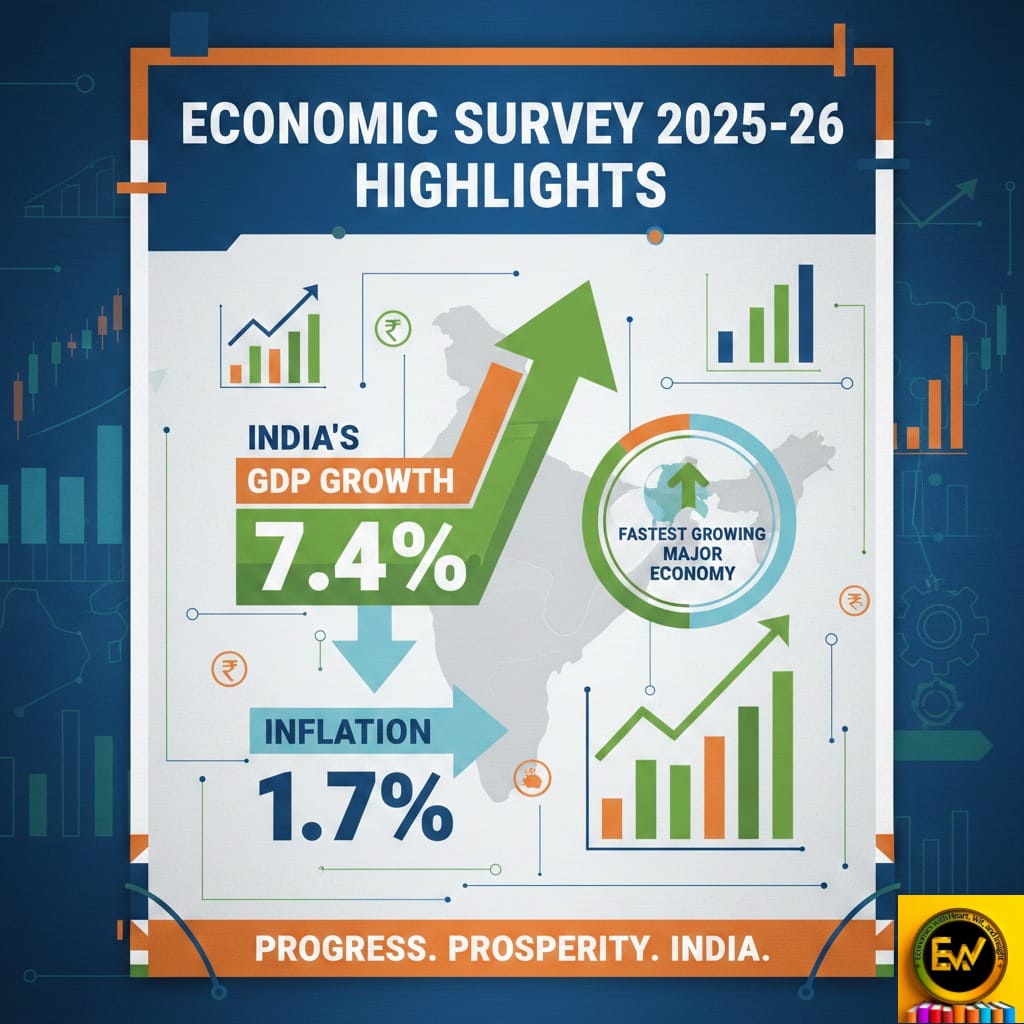
Complete Analysis of the Economic Survey 2025-26
The Economic Survey 2025-26, presented on January 29, 2026, offers a mostly positive outlook on…

The Indo-Pacific: A Geoeconomic and Strategic Epicenter
The Indo-Pacific has become the world’s most dynamic economic region. It is home to over…
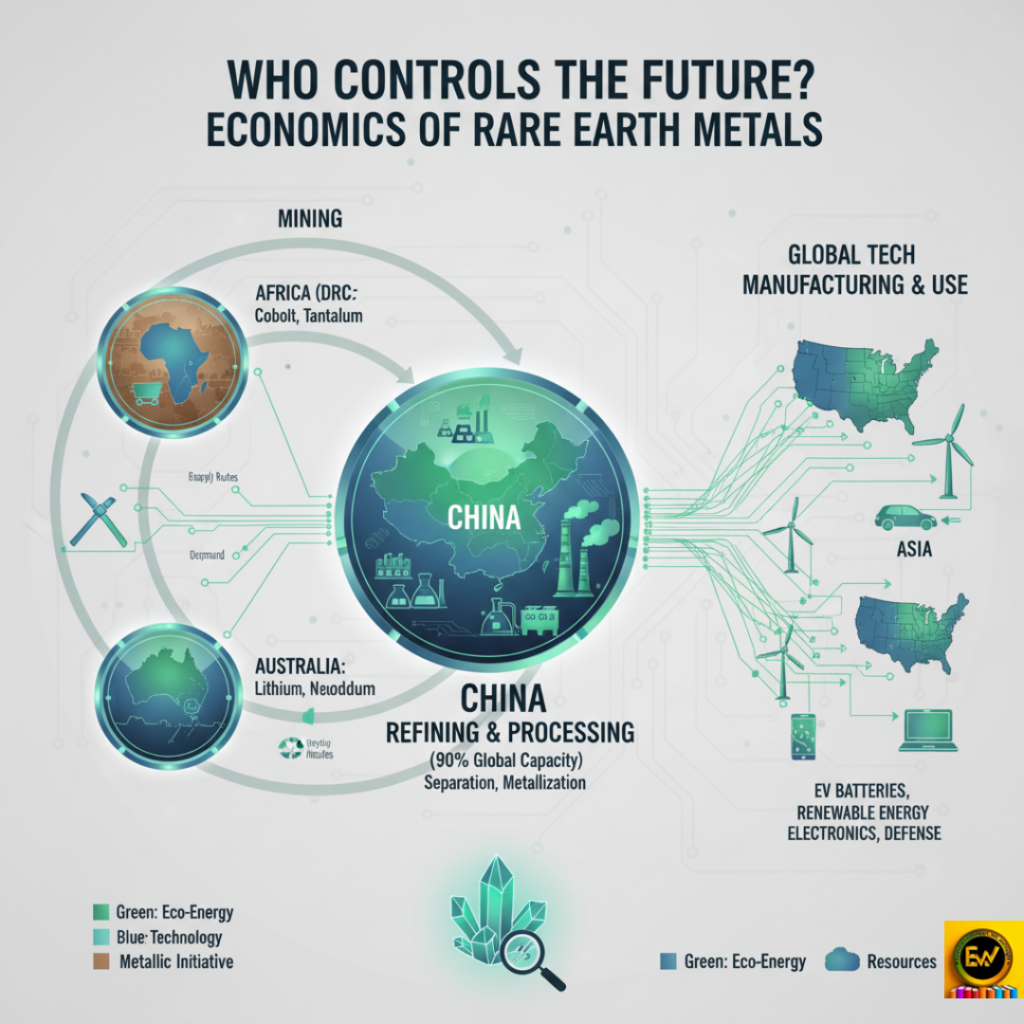
Economics of Rare Earth Metals
Rare earth elements and critical minerals are vital for clean energy and technology. They form…
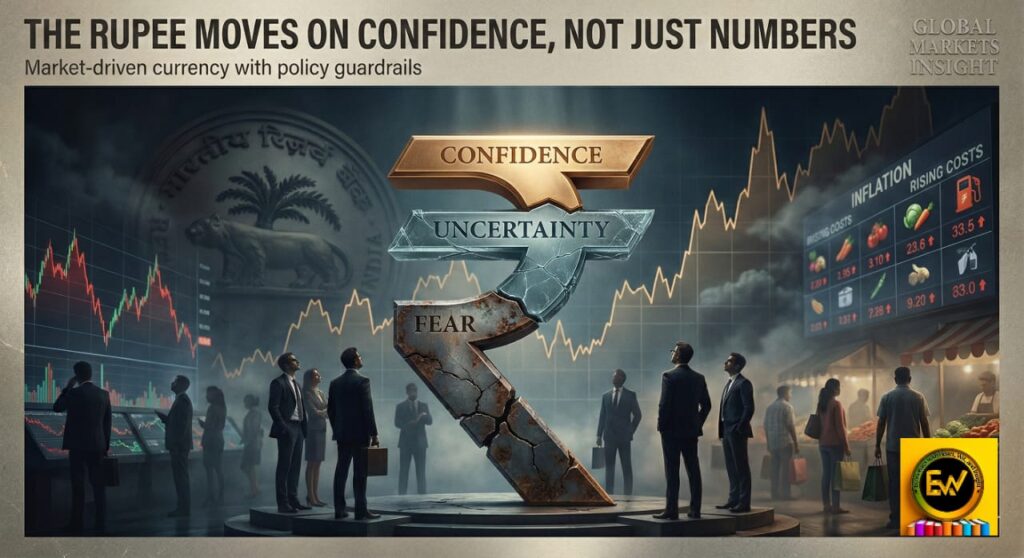
Indian Rupee Depreciation Against the US Dollar
Introduction In recent years, the Indian Rupee has undergone significant depreciation against the US Dollar,…



-
-
-
-
-
-
-
-
-
-
-
-
-
-
-
-
-
-
-
-
-
-
-
-
Show CommentsCan you be more specific about the content of your article? After reading it, I still have some doubts. Hope you can help me. https://www.binance.info/es-MX/register?ref=GJY4VW8W
Your article helped me a lot, is there any more related content? Thanks! https://accounts.binance.com/en-ZA/register?ref=B4EPR6J0
Can you be more specific about the content of your article? After reading it, I still have some doubts. Hope you can help me.
Thanks for sharing. I read many of your blog posts, cool, your blog is very good. https://www.binance.info/register?ref=IXBIAFVY
I don’t think the title of your article matches the content lol. Just kidding, mainly because I had some doubts after reading the article.
Alright, so I stumbled upon five888! Heard from someone in reddit. It’s got a decent selection of games. Not the flashiest site ever! Give it a shot: five888
Yo, check out g66! I’ve been playing around on it for a while now, and things are pretty good. Nice interface and a bunch of different options. It’s worth checking out! g66
Giving lk88 a go… not bad! I was really surprised. I suggest you check it before it’s too late! lk88
Your point of view caught my eye and was very interesting. Thanks. I have a question for you. https://accounts.binance.com/en/register?ref=JHQQKNKN
Thanks for sharing. I read many of your blog posts, cool, your blog is very good. https://www.binance.com/register?ref=IXBIAFVY
I don’t think the title of your article matches the content lol. Just kidding, mainly because I had some doubts after reading the article. https://www.binance.info/register?ref=IHJUI7TF
Thank you for your sharing. I am worried that I lack creative ideas. It is your article that makes me full of hope. Thank you. But, I have a question, can you help me? https://accounts.binance.info/zh-CN/register-person?ref=WFZUU6SI
Thank you for your sharing. I am worried that I lack creative ideas. It is your article that makes me full of hope. Thank you. But, I have a question, can you help me?
Thank you for your sharing. I am worried that I lack creative ideas. It is your article that makes me full of hope. Thank you. But, I have a question, can you help me?
Can you be more specific about the content of your article? After reading it, I still have some doubts. Hope you can help me.
Reading your article helped me a lot and I agree with you. But I still have some doubts, can you clarify for me? I’ll keep an eye out for your answers.
Can you be more specific about the content of your article? After reading it, I still have some doubts. Hope you can help me.
I don’t think the title of your article matches the content lol. Just kidding, mainly because I had some doubts after reading the article.
I don’t think the title of your article matches the content lol. Just kidding, mainly because I had some doubts after reading the article.
Thank you for your sharing. I am worried that I lack creative ideas. It is your article that makes me full of hope. Thank you. But, I have a question, can you help me? https://www.binance.com/register?ref=IHJUI7TF
Can you be more specific about the content of your article? After reading it, I still have some doubts. Hope you can help me. https://www.binance.com/zh-CN/register?ref=WFZUU6SI
Can you be more specific about the content of your article? After reading it, I still have some doubts. Hope you can help me.
Your point of view caught my eye and was very interesting. Thanks. I have a question for you.
Your article helped me a lot, is there any more related content? Thanks!