
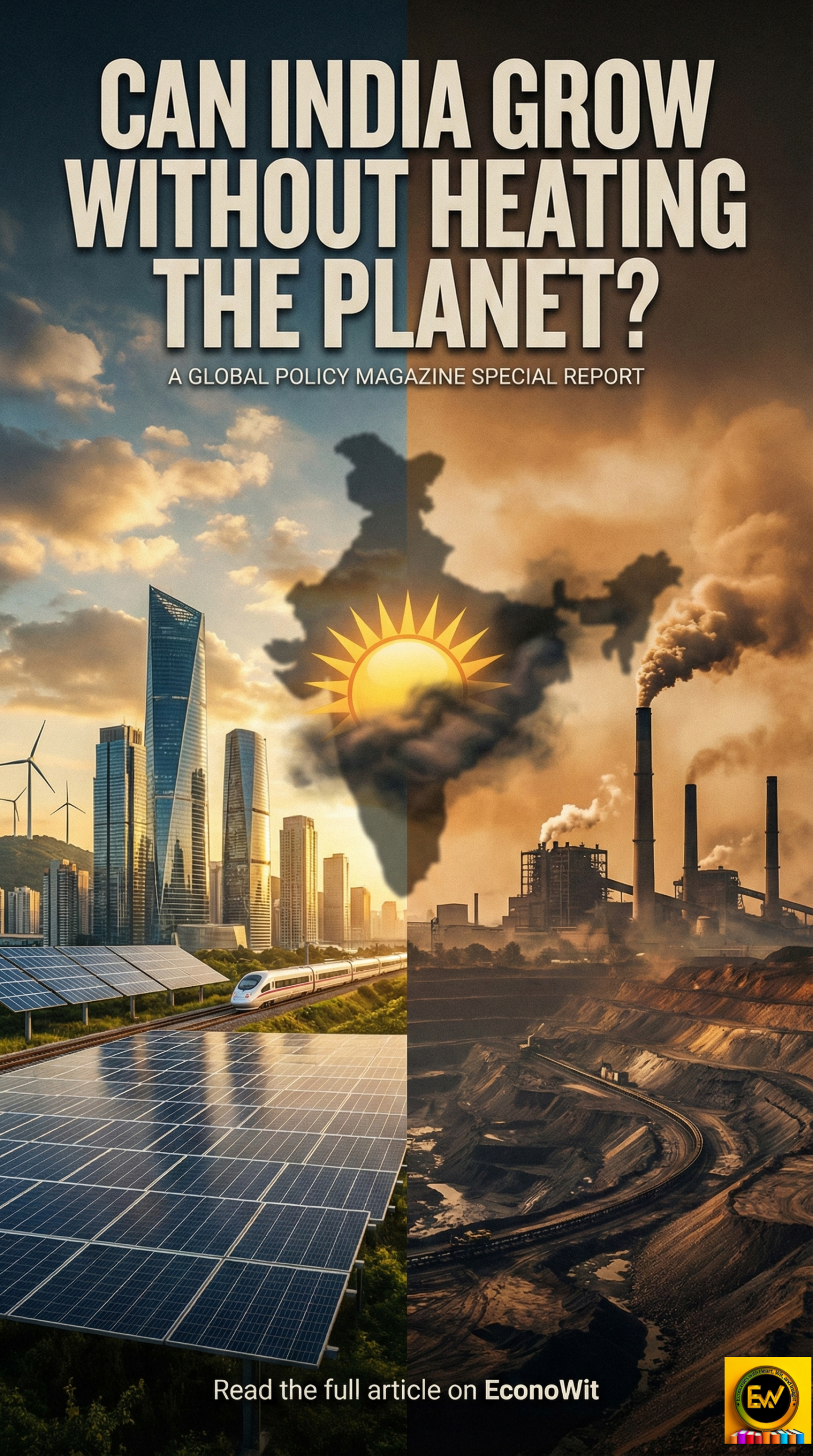
Green Economy: Can India Balance Growth with Climate Goals?

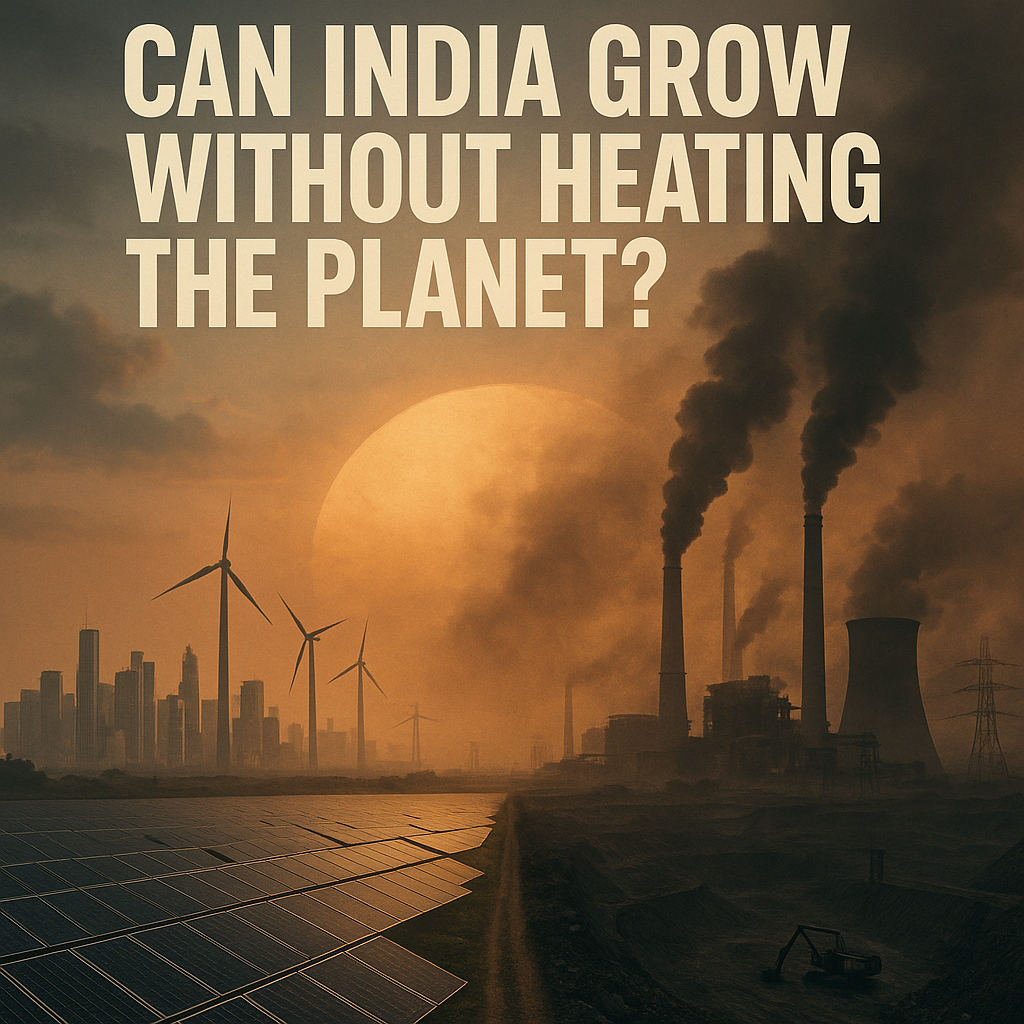
India stands at a crucial point in history. As the world’s most populous nation and fastest-growing major economy, it faces a unique challenge. It must achieve what took wealthy nations a century—industrialisation, poverty reduction, and decarbonization—in just three decades.
The numbers reveal a clear picture. India’s economy grew by 7.8% in 2023, making it the world’s fourth-largest economy, with a GDP of $3.78 trillion. However, this impressive growth has a significant carbon footprint. India is now the world’s third-largest emitter of greenhouse gases, with coal still accounting for approximately 75% of its electricity generation. The key question isn’t whether India will grow—it will. The real question is whether it can break the historical connection between economic growth and carbon emissions.
“India is not ready to say goodbye to coal or phase out its use. It is hard to triple your electricity system while also decarbonizing and ensuring people have quality power.”
Sandeep Pai, RMI India
The Development Imperative: Why India Can’t Simply “Go Green”
To understand India’s dilemma, consider this: per-capita electricity consumption is about 1,300 kWh, which is less than one-third of the global average. Nearly 200 million Indians still lack clean cooking fuel and rely on wood or dung instead. Around 2000, almost half the population lived without reliable power.
India must triple its entire energy system just to reach living standards that match the world average. This isn’t about luxury; it’s about basic human dignity. Every percentage point of GDP growth lifts millions out of poverty. Between 2011 and 2023, about 171 million people escaped extreme poverty. But there is a mathematical trap: India’s GDP is expected to grow nearly 9% between 2022 and 2028, while carbon dioxide emissions from energy have been increasing by 3.6% each year. Even with decreasing emissions intensity, total emissions keep rising because GDP growth far exceeds efficiency gains.
The Paradox of Progress: Record Renewables, Rising Coal
India’s energy story contains a surprising contradiction. The country has achieved what many thought was impossible:
The Renewable Revolution:
- Surpassed its 50% non-fossil electricity capacity target years ahead of the 2030 deadline.
- Added 91 GW of solar and 27 GW of wind since 2014.
- Saw renewable energy investment surge 91.5% between 2023 and 2024.
- Achieved solar tariffs below ₹2.50 per kWh, which is cheaper than new coal.
The Coal Reality:
- Coal production hit a record 1.04 billion tonnes in 2024-25.
- Approximately 27 GW of coal capacity is currently under construction.
- 92 GW are in the pre-construction phase.
- Coal met 64% of electricity demand growth in 2024.
This isn’t a contradiction; it’s a strategy. India is using an “all-of-the-above” approach by adding both clean energy and coal at the same time to tackle the rapid rise in demand. Peak electricity demand reached 241 GW in June 2025, driven by extreme heat and increasing cooling needs.
The Hidden Bottlenecks: Why Success Isn’t Guaranteed
The $10.1 Trillion Finance Chasm
The biggest barrier isn’t technology; it’s money. India needs $10.1 trillion to reach its net-zero target by 2070. The current annual climate investment is only $44 billion. The gap between what is needed and what is available is so large that it shapes the whole strategy.
India requires between $170 billion and $263 billion each year until 2030. Right now, it gets less than one-fifth of that amount. This isn’t just a request for help; it’s a legal claim. India says that developed countries have failed to meet their Paris Agreement commitments to provide “new and additional” funds and technology transfer.
The DISCOM Death Trap
Here’s the hidden killer of the transition. India’s state-owned electricity distribution companies, or DISCOMs, are consistently bankrupt. Yet they are the only buyers of renewable energy in most states. A developer cannot get financing for a multi-million-dollar solar park without a reliable Power Purchase Agreement. But a bankrupt DISCOM cannot sign a trustworthy PPA.
The logic is clear. India’s net-zero goal for 2070 is dependent on the financial health of local utilities influenced by short-term state politics. Until this issue is addressed, the entire renewable movement stands on unstable ground.
The 900 TWh Steel Problem
Consider India’s path to green steel—replacing coal with green hydrogen in production. The electricity requirement? 900 TWh annually—equivalent to 65% of India’s total national electricity production today. Just for steel.
This single number changes everything. India cannot simply build a green grid for its current needs. It must build that grid, then build a second grid 65% larger just to power its steel industry. This scale demands either unprecedented renewable deployment or a pragmatic pivot to nuclear baseload power.
The Just Transition Time Bomb
In Jharkhand alone, the shift to clean energy could cost the state ₹725.9 billion ($8.7 billion) each year. This represents a 5.1% drop in total state revenues and a 7.7% decline in GDP. Over 15 million people in coal mining areas earn their livelihoods directly or indirectly from coal, with 70% being part of tribal communities.
No state government can survive a 5% loss in revenue. Without a multi-billion-dollar federal Just Transition Fund to support coal-dependent states, these regions will use their political power to oppose the national climate agenda.
The Carbon Credit Strategy: Efficiency Without Pain
In July 2024, India launched its Carbon Credit Trading Scheme, but not a carbon tax. It’s a rate-based Emissions Trading System that sets efficiency goals without limiting total emissions. A steel company can double its production and emissions as long as it does so more efficiently than the target.
This approach closely follows the national strategy: a 45% cut in emissions intensity by 2030, rather than an absolute decrease in emissions. This lets India present itself as a climate leader while still promoting industrial growth. It’s clever politics, but is it enough for the planet’s survival?
Three Futures: From Transformation to Catastrophe
1: Accelerated Transition (Best Case)
- Strong carbon pricing by 2028.
- International climate finance reaches over $100 billion annually.
- Grid infrastructure and storage grow quickly.
- Outcome: Renewable capacity exceeds 750 GW by 2040. Coal generation peaks by 2030.
- Risk: Stranded coal assets cause economic crises. Transition costs strain state budgets.
2: Pragmatic Evolution (Middle Path)
- Current momentum continues with modest increases in finance.
- Coal levels out by 2035 but declines slowly.
- Outcome: 600 GW of renewables by 2040. Coal still provides 35-40% of electricity.
- Risk: Not enough for net-zero by 2070. Climate effects harm growth.
3: Delayed Action (Catastrophic)
- Policy implementation weakens, and international finance falls short.
- Fossil fuel lobbies slow down the transition. Grid bottlenecks remain.
- Outcome: 400 GW of renewables by 2040. Coal growth continues through the 2030s.
- Risk: Net-zero by 2070 becomes unreachable. Catastrophic climate effects occur.
The Verdict: Qualified Hope, Conditional Success
Can India balance rapid economic growth with climate goals? The answer is a qualified yes, but only under specific conditions that are not fully in place.
What’s Working:
- Renewable energy costs have dropped to competitive levels.
- There is a policy framework, although it has inconsistencies.
- Private sector involvement is strong and increasing.
- India has shown it can deploy large-scale infrastructure.
What’s Failing:
- Total emissions keep rising, even with efficiency improvements.
- The expansion of coal infrastructure runs counter to transition timelines.
- Planning for a fair transition is still insufficient.
- International climate finance is falling short.
- Grid infrastructure and storage have not kept pace with generation capacity.
The Path Forward:
India will likely take a practical approach that leads to significant progress, though it won’t fully meet the 1.5°C target without major changes. Success depends on three conditions happening at the same time:
- Domestic Political Will: Accept short-term economic trade-offs, enforce clear policies, and turn the concept of a fair transition into reality.
- International Support: Developed countries need to fulfil their financial and technological commitments, seeing it as a shared responsibility, not as charity.
- Technological Acceleration: Innovations in storage, hydrogen, and industrial decarbonization must happen faster than expected.
The Global Stakes
India’s choice will influence not only its future but also the path of global climate action. As a leader in the Global South, India’s actions will guide many developing countries as they manage their own transitions.
The main challenge is timing. India needs to achieve what took Europe and America 150 years in just 30 years. At the same time, it must deal with climate impacts from the historical emissions of others. This places a heavy burden on a nation that is still battling poverty, asking it to lead in climate efforts without the financial resources that helped wealthy nations develop.
The issue isn’t about fairness; it’s about possibility.
What compromises should India make to achieve both growth and climate resilience? The answer could shape not only India’s future but also show whether green growth is possible for countries that are still advancing economically.
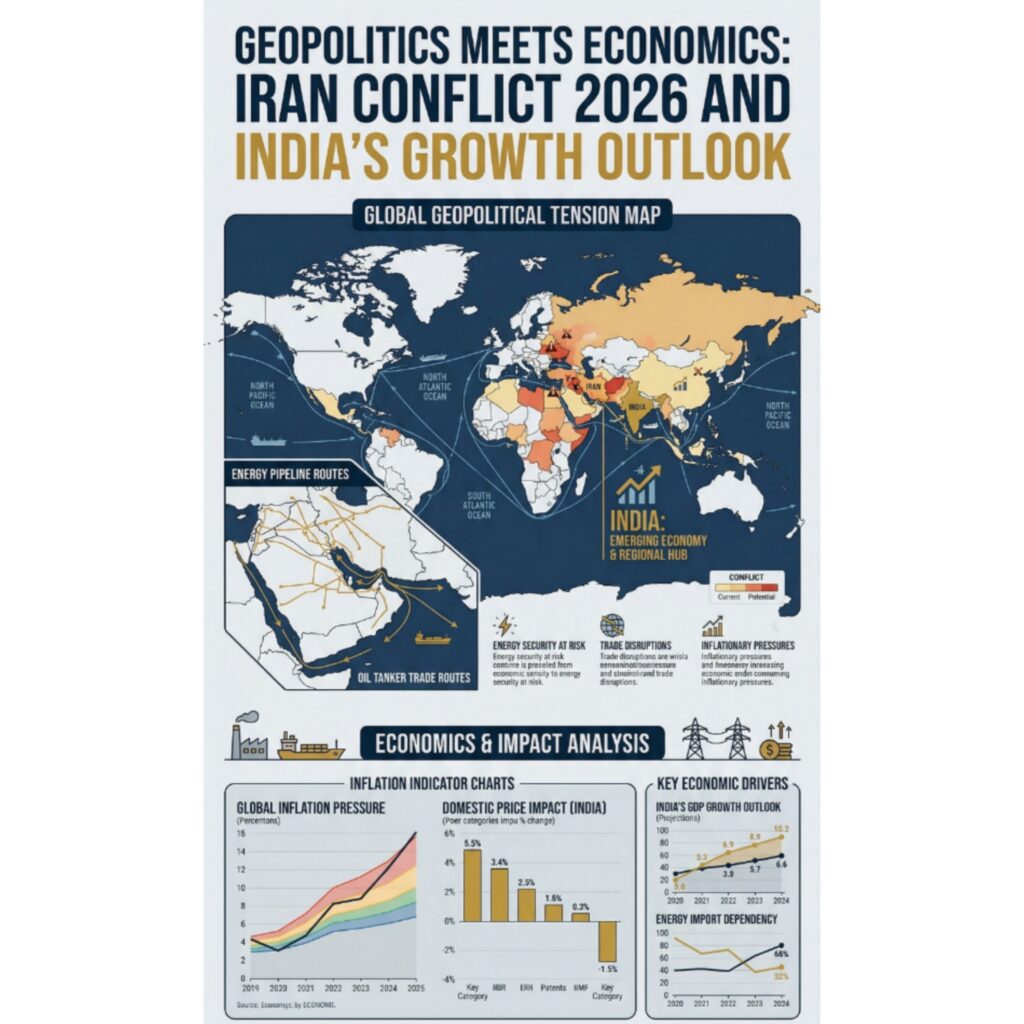
How the 2026 Iran Conflict Could Reshape India’s Inflation, Energy Security and Growth
The March 2026 U.S.-Israel air strikes against Iran have sparked a broader Middle East war…
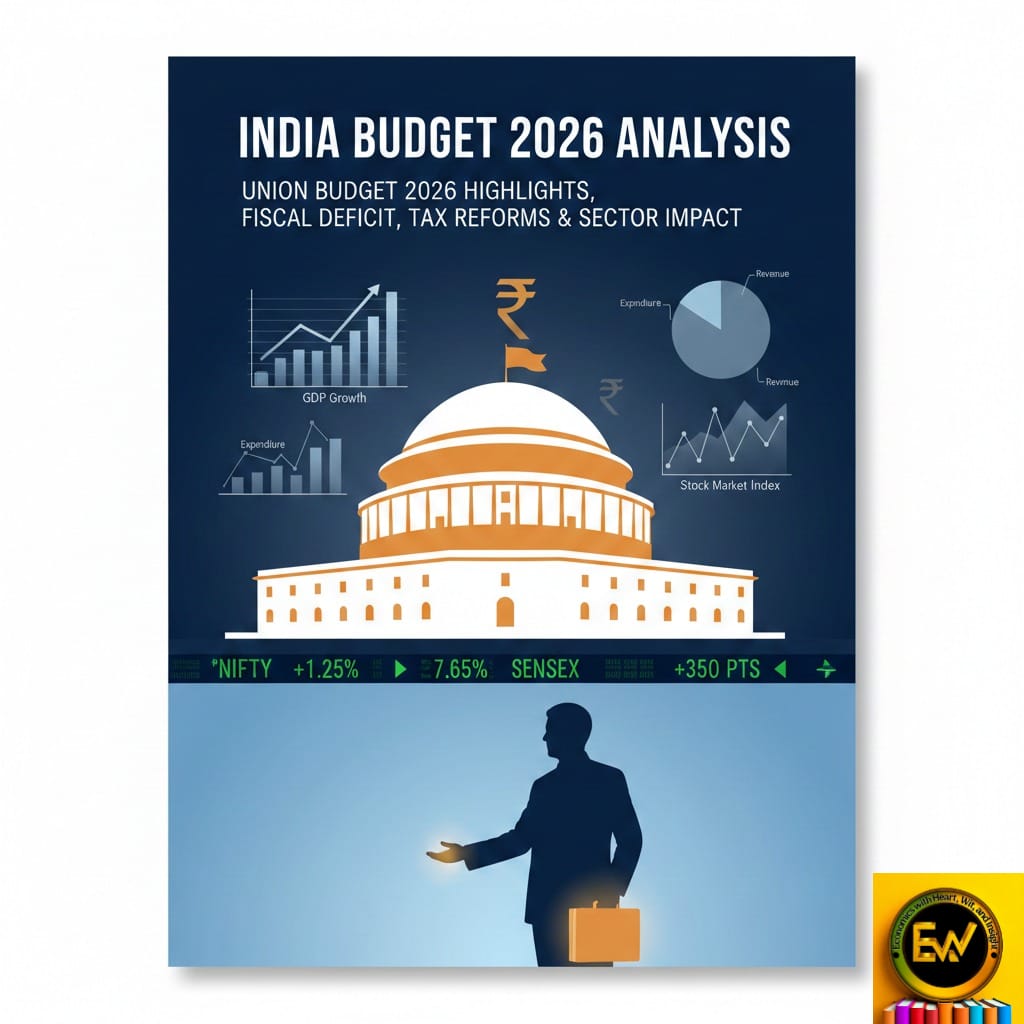
Union Budget 2026 – Overview and Analysis
The Union Budget 2026-27 was presented on Feb 1, 2026. Continued the government’s multi-year plan…
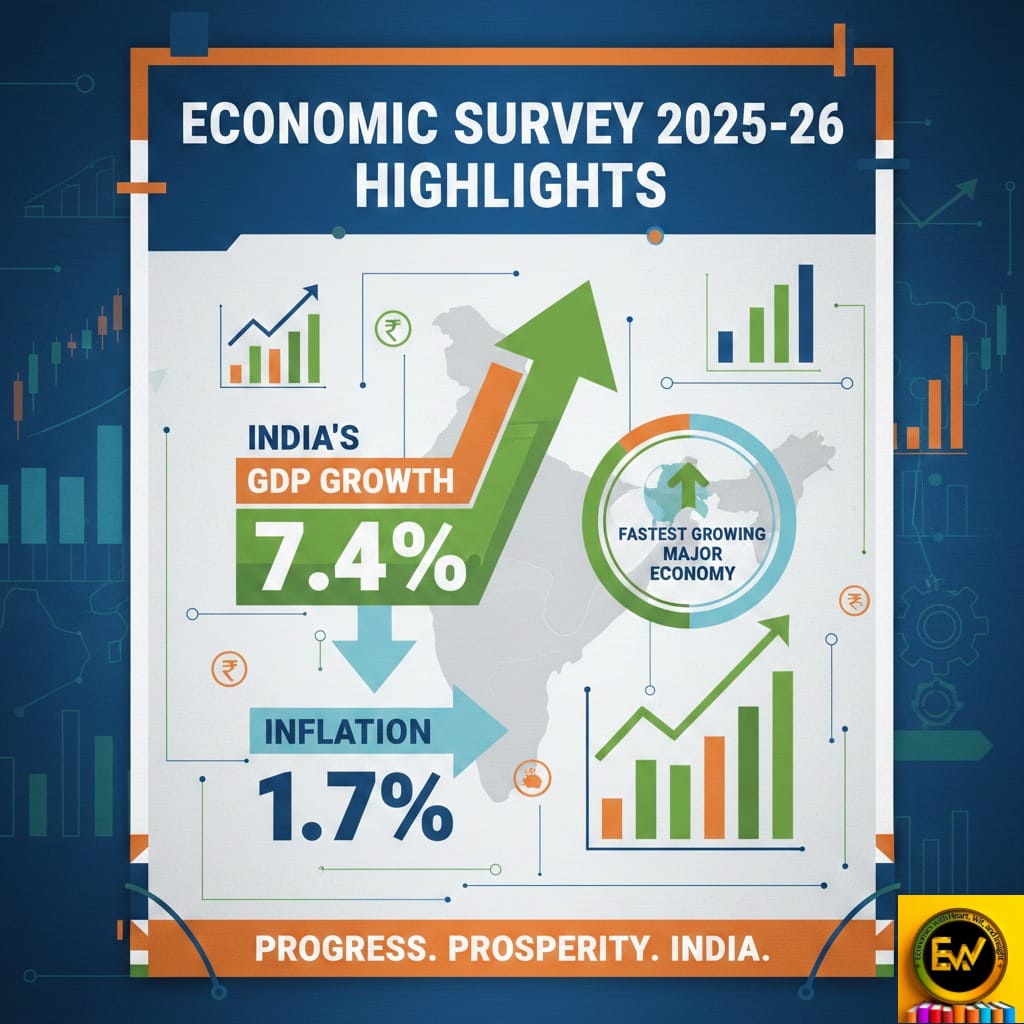
Complete Analysis of the Economic Survey 2025-26
The Economic Survey 2025-26, presented on January 29, 2026, offers a mostly positive outlook on…

The Indo-Pacific: A Geoeconomic and Strategic Epicenter
The Indo-Pacific has become the world’s most dynamic economic region. It is home to over…
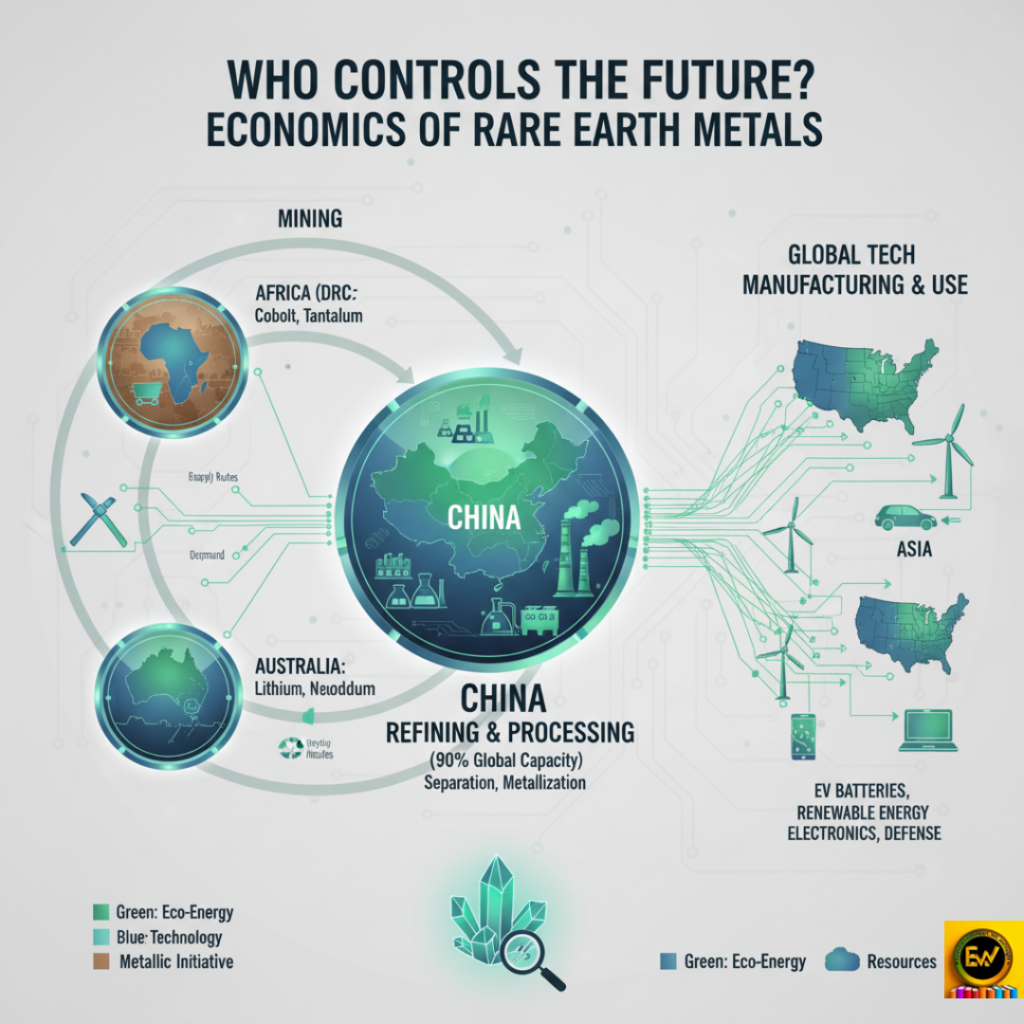
Economics of Rare Earth Metals
Rare earth elements and critical minerals are vital for clean energy and technology. They form…
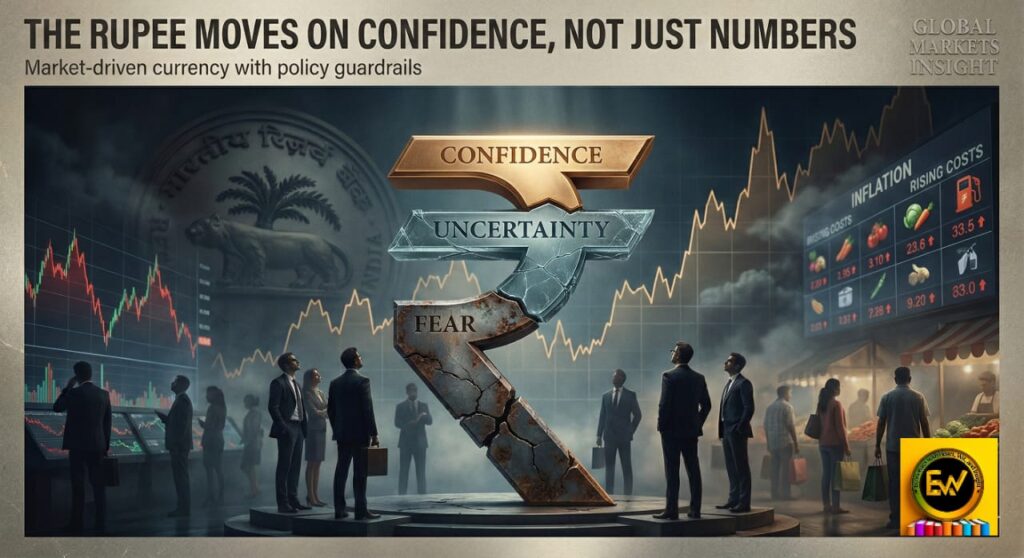
Indian Rupee Depreciation Against the US Dollar
Introduction In recent years, the Indian Rupee has undergone significant depreciation against the US Dollar,…


Informative, Insightful
Keep going
Thank you🤗🤗🤗
[…] The Economic Survey stresses the need to move up the value chain, shifting from labour-intensive production to high-tech manufacturing, as part of the “Make in India” vision. It notably points out the India Semiconductor Mission, where 10 semiconductor projects worth around ₹1.6 lakh crore have been approved, indicating progress in critical high-tech areas. At the same time, there are ongoing efforts to scale MSMEs through credit linkages and infrastructure corridors, along with improvements in the ease of doing business. The Survey also notes India’s gains in innovation. For instance, India rose to 38th in the Global Innovation Index in 2025, up from 66th in 2019, pointing to a growing startup and R&D ecosystem that can boost manufacturing growth. […]