
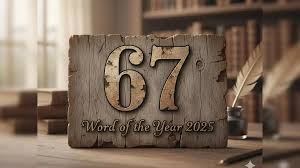
“Understanding ‘67’: The Viral Gen Alpha Slang That Became Word of the Year 2025”

Every year, Dictionary.com selects a term that captures the spirit of the times. However, in 2025, the choice surprised many. Instead of a conventional word, the platform chose “67” — pronounced six-seven — as its Word of the Year. Although it may appear strange at first, a closer look reveals why this seemingly random number has become a linguistic phenomenon.
What Is “67”?
To begin with, “67” is not a word in the traditional sense. Instead, it functions as a slang expression widely used by Gen Alpha, especially on TikTok. Because its meaning is intentionally vague, it is often used as an interjection — a quick, energetic exclamation that expresses a feeling rather than a specific idea.
Moreover, “67” is frequently accompanied by a recognizable gesture: both palms held up and moved alternately. Therefore, it operates not only as language but also as a visual performance, making it ideal for short-form video culture.
Where Did “67” Come From?
Furthermore, the origins of “67” can be traced back to the song “Doot Doot (6 7)” by the artist Skrilla. After the track began circulating on social media, users started repeating “six-seven” in dance routines, jokes, and reaction videos. Consequently, the term spread rapidly, crossing from TikTok into classrooms, playgrounds, and group chats.
Why Did Dictionary.com Pick It?
According to Dictionary.com, one key reason behind the selection is the dramatic rise in searches for “67.” Beginning in mid-2025, inquiries on the platform increased several times over. This surge indicated that people of all ages were curious — either because they wanted to understand what Gen Alpha was saying or because they had encountered the term repeatedly online.
In addition, lexicographers noted that “67” represents a new phase in language evolution. Unlike past Words of the Year, which often reflected political, environmental, or social themes, “67” highlights how internet culture now drives linguistic change. Since the term does not have a fixed definition, it symbolizes the fluidity and playfulness of modern communication.
How Do People Use “67”?
On one hand, many young users employ “67” simply as a fun, meaningless phrase. On the other hand, because it lacks a strict definition, it can also express a wide range of attitudes — from mild indifference to playful confusion. Therefore, the flexibility of “67” is part of its appeal.
For example:
- If something is “kind of okay,” someone might shrug and say, “67.”
- When a situation gets weird or doesn’t make sense, saying ’67’ makes it funny instantly.
- Friends use ’67’ as an inside joke that brings them together.
- Thus, the beauty of “67” lies not in what it literally means but in how it connects people.
What Does “67” Tell Us About Today’s Society?
To put it another way, “67” reflects broader changes in how language works. As digital communication grows more visual, faster, and more meme-driven, young people rely less on traditional grammar and more on shared cultural signals. Because of this shift, expressions like “67” emerge naturally from online spaces.
In addition, the popularity of “67” shows a clear generational contrast. While Gen Alpha embraces the term, older generations often find it confusing. As a result, conversations about “67” highlight the evolving gap between how different age groups perceive meaning and communication.
Why This Choice Is Important
Ultimately, Dictionary.com’s selection signals that language today is not limited to dictionaries or formal contexts. Instead, it is shaped by music, memes, viral trends, and digital communities. “67” is therefore more than a number; it is a reminder that language is alive, flexible, and constantly reinvented by the people who use it.
Conclusion
In conclusion, “67” as the Word of the Year for 2025 captures a unique moment in linguistic history. Although it may seem unconventional, it perfectly represents the creativity and spontaneity of young digital culture. Through its ambiguity, humour, and performative nature, “67” highlights how language continues to evolve in surprising ways — connecting people even when the meaning is not entirely clear.