
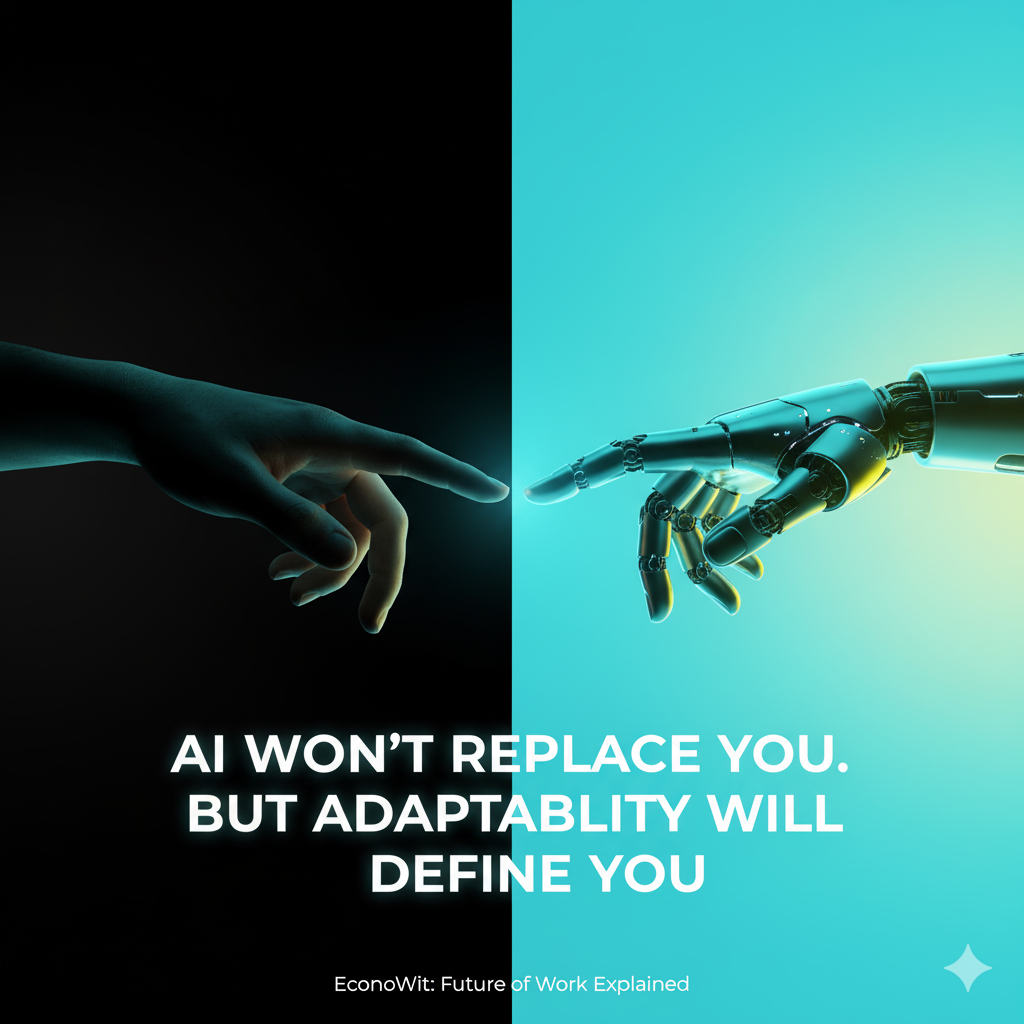
AI & Job Polarisation: Will AI Create More Jobs Than It Destroys?

“AI could replace 300 million jobs worldwide, but it could also create even more.” This paradox lies at the centre of today’s debate about the labour market. From call centres in India to high-tech areas in Silicon Valley, artificial intelligence is changing not only how we work but also who can work. The key question is no longer if AI will change jobs; it’s how societies will handle that change.
Artificial Intelligence (AI) is no longer just a buzzword; it’s a force changing the way we live, work, and envision the future. However, as machines become smarter, a crucial question emerges: Will AI create more jobs than it eliminates? The answer is not straightforward and falls somewhere between hope and caution.
Understanding Job Polarisation in the AI Era
Job polarisation refers to the decline of the middle class in the job market. In simple terms, we see growth at both ends of the spectrum: high-skill, high-wage jobs like AI engineers and data scientists, and low-skill, low-wage jobs such as delivery or care work. Meanwhile, middle-skill roles, including clerks, routine manufacturing, and back-office staff, are decreasing.
AI takes this trend further. Unlike earlier technologies, it doesn’t just focus on repetitive tasks. It can now write code, draft legal briefs, analyse data, and even create content. This means that not only are clerical roles at risk, but also entry-level white-collar jobs. At the same time, high-skill AI engineers and low-skill human-centred roles are on the rise.
The Global Landscape: Disruption with Net Gains
- Goldman Sachs warns that up to 300 million jobs could be automated globally.
- McKinsey projects massive churn—400–800 million jobs displaced by 2030—yet many new ones created.
- World Economic Forum estimates that by 2030, 170 million new jobs will be created vs. 92 million lost, yielding a net gain of 78 million.
Sectors most at risk include retail, manufacturing, customer service, and clerical work. But AI also increases demand in healthcare, education, green energy, cybersecurity, and creative industries.
This dynamic reveals the dual nature of AI: it simultaneously destroys tasks while creating industries.
| Source | Jobs Displaced (Global) | Jobs Created (Global) | Net Change | Key Assumptions & Notes |
| World Economic Forum (WEF) | 92 Million (by 2030) | 170 Million (by 2030) | +78 Million | Based on surveys of large firms. Assumes proactive investment in workforce upskilling. Highlights significant churn. |
| Goldman Sachs | 300 Million (full-time job equivalent) | Not quantified, but expects new jobs to offset losses long-term. | Temporarily Negative, Long-term Neutral/Positive | Displacement figures represent the number of workers who may need to switch occupations. Emphasises the scale of the required workforce transition is historically unprecedented. |
| McKinsey Global Institute | 400-800 Million (by 2030) | Not quantified, but models job creation from multiple drivers (e.g., rising consumption, healthcare needs). | Contingent on Growth & Investment | Analysis of job ads shows AI-exposed sectors have higher productivity, wages, and job posting growth, suggesting AI is being used for value creation (augmentation) more than headcount reduction. |
| PwC | Not quantified | Not quantified | Strongly Positive | Analysis of job ads shows AI-exposed sectors have higher productivity, wage, and job posting growth, suggesting AI is being used for value creation (augmentation) more than headcount reduction. |
India’s Unique Position: Risks and Opportunities
India is both vulnerable and advantaged in this transition:
- Vulnerabilities:
- 90% of workers are in the informal sector with limited safety nets.
- Educated youth face a staggering 66% unemployment.
- IT and BPO sectors—long India’s strength—see routine tasks automated.
- Opportunities:
- India leads in enterprise AI adoption (30% vs. 26% global average).
- McKinsey projects 60–65 million digital jobs by 2025, even as 40–45 million are displaced.
- The IndiaAI Mission and Skill India Digital Hub aim to reskill millions in AI, data, and cybersecurity.
The government has started programs such as the IndiaAI mission, Skill India, and Digital Hub partnerships with Microsoft and Intel to help reskill millions. However, a major challenge still exists: will this training extend beyond cities and support women and informal workers?
Jobs at Risk vs. Jobs of the Future
At risk in India and globally:
- Call centre & BPO jobs
- Data entry and clerical roles
- Routine manufacturing and assembly-line work
- Basic IT coding, design, and sales tasks
Emerging and growing roles:
- AI/ML engineers, data scientists, cybersecurity experts
- Prompt engineers (for generative AI)
- Cloud infrastructure specialists
- Healthcare workers, teachers, and social service providers
- Creative professionals augmented by AI tools
The shift is clear: routine skills are fading, human-centred and tech-driven skills are booming.
Expert Perspectives: Optimism Meets Caution
- Erik Brynjolfsson (MIT): AI should augment workers, not replace them—boosting productivity for novices while preserving human judgment.
- Lawrence Summers (Harvard): AI will reorganise industries, ending the old “barbell” job market and pushing dominance toward highly skilled roles.
- Sam Altman (OpenAI): Gen Z are the “luckiest kids in history”—AI frees them from rote work and empowers creativity.
- Daron Acemoglu (MIT): Warns against over-automation—AI must create new tasks, not just replace humans, to ensure broad prosperity.
- Mo Gawdat(former Google executive): He predicts AI could “eat away” at middle-class jobs by 2027 and create social upheaval before a better phase arrives
Together, these voices emphasise a simple truth: AI’s impact is not predetermined—it depends on choices made by policymakers, companies, and workers.
Policy, Corporate Strategy, and Individual Adaptation
The rise of artificial intelligence is not just a change in technology. It brings a social and economic transformation. Whether AI creates more jobs than it eliminates will depend on how governments, businesses, and individuals react today. The future of work is not set in stone. It is shaped by policies, business strategies, and our ability to adjust.
The Role of Government: Building a Future-Ready Workforce
Governments are mainly responsible for making sure that the advantages of AI are shared widely in society. Updating the social contract is crucial to balance innovation with protecting workers.
🔹 Investing in Education and Training
AI literacy should be part of school curricula. The current workforce needs widespread reskilling and upskilling programs. Dedicated funds for AI worker training, partnerships between industry and academia, and digital bootcamps can help workers move into AI-augmented jobs instead of being left behind.
🔹 Strengthening Social Safety Nets
As AI changes industries, millions of workers will have to move to new jobs. Stronger unemployment insurance, portable healthcare, and pension reforms can offer support during these changes. A tight labour market, backed by stable economic conditions, will also give workers better bargaining power.
🔹 Modernising Labour Laws
AI is changing the nature of work, and regulations need to keep pace. Updating laws like WARN (Worker Adjustment and Retraining Notification) to address tech-driven layoffs, requiring transparency in AI-driven hiring and firing decisions, and banning invasive AI surveillance will protect worker rights. Governments that establish ethical AI standards will not only safeguard citizens but also build global trust.
Corporate Responsibility: From Automation to Augmentation
Businesses are leading the way in adopting AI. However, companies that see AI simply as a way to cut costs may face long-term failure. The successful ones will be those who invest in people and rethink work for collaboration between humans and AI.
🔹 Upskilling and Reskilling as a Core Strategy
According to global reports, skills in AI-related jobs are changing 66% faster than in other roles. Smart companies are investing in training programs instead of relying on “fire-and-hire” strategies. 85% of employers plan to focus on reskilling for the AI future. This approach improves both productivity and employee loyalty.
🔹 Adopting Growth-Oriented AI Strategies
AI should be viewed as a tool for innovation and market growth, not just for reducing staff. By equipping employees with AI, companies can develop new products, services, and revenue sources. This approach drives growth instead of fear.
🔹 Workflow Redesign for Human-AI Collaboration
The real value of AI is in rethinking workflows. Businesses need to look at tasks, see where AI can automate, where it can support, and where human creativity is essential. Companies that get this balance right will have a lasting competitive advantage.
The Individual Mandate: Future-Proofing Your Career
In an AI-driven economy, lifelong learning is no longer optional—it’s survival. Individuals must take charge of their own growth, developing skills that AI cannot easily replace.
🔹 Embrace Lifelong Learning
By 2030, 39% of essential job skills are expected to change. Traditional education can’t support a 40-year career anymore. Workers need to keep improving through micro-credentials, online courses, and on-the-job learning.
🔹 Focus on Human-Centric Skills
AI can handle tasks like data analysis and coding, but it has a hard time with critical thinking, creativity, empathy, and leadership. Workers who develop these uniquely human skills will stay essential.
🔹 Adaptability is the New Superpower
The ability to adjust to new tools, roles, and industries will be more valuable than mastering any one software. Being flexible, curious, and skilled at solving problems will shape future career success.
Conclusion: Shaping the Future of Work
The debate over AI and jobs is not just about “creation vs. destruction.” It focuses more on transition versus adaptation. AI will likely create more jobs than it takes away. However, those jobs will not automatically go to the workers who are displaced.
For India, this situation presents both a warning and an opportunity. With the world’s largest youth population and a rapidly growing digital economy, India can harness AI as a strong driver of inclusive growth. Still, without intentional actions on skills and policy, there is a real risk of increased inequality and job polarisation.
The key question is not “Will AI take our jobs?” Instead, it is “How will we adjust, retrain, and redesign work so that AI benefits everyone?”
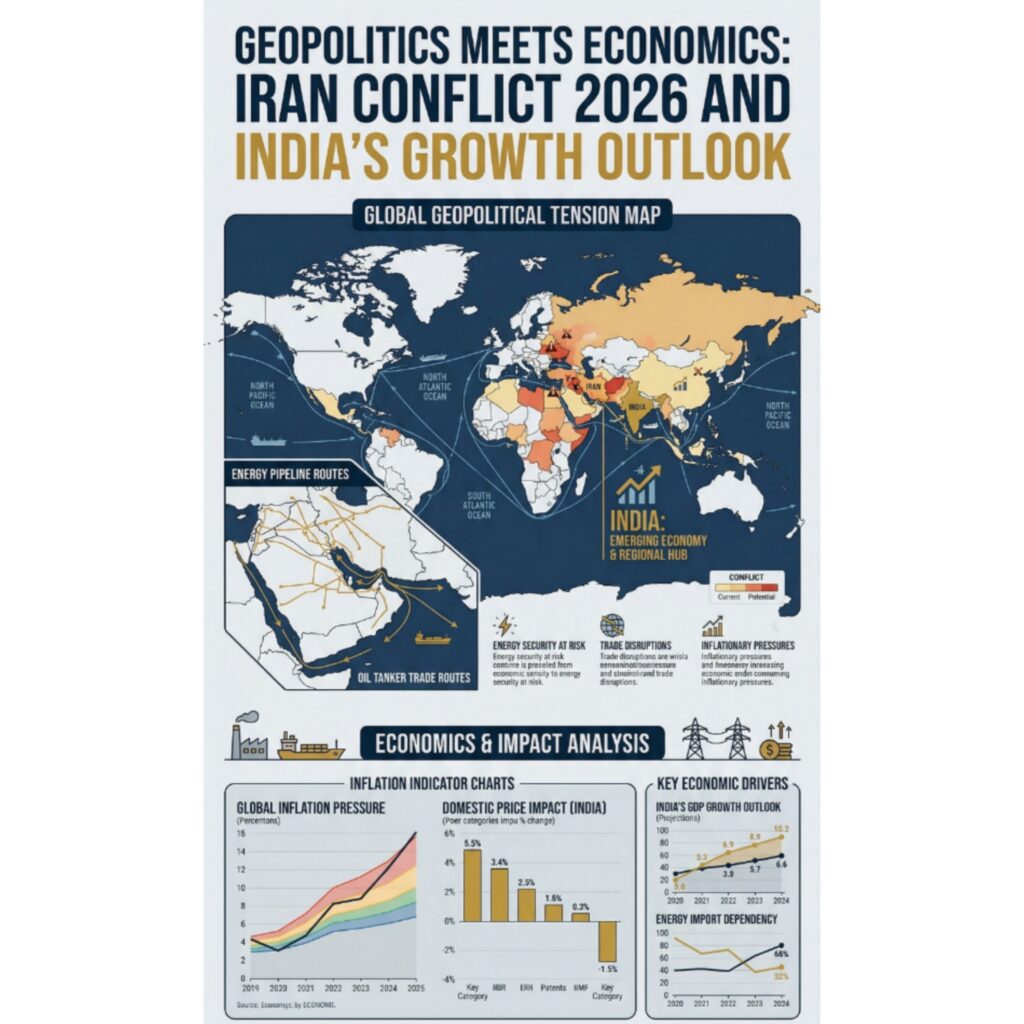
How the 2026 Iran Conflict Could Reshape India’s Inflation, Energy Security and Growth
The March 2026 U.S.-Israel air strikes against Iran have sparked a broader Middle East war…

Union Budget 2026 – Overview and Analysis
The Union Budget 2026-27 was presented on Feb 1, 2026. Continued the government’s multi-year plan…

Complete Analysis of the Economic Survey 2025-26
The Economic Survey 2025-26, presented on January 29, 2026, offers a mostly positive outlook on…

The Indo-Pacific: A Geoeconomic and Strategic Epicenter
The Indo-Pacific has become the world’s most dynamic economic region. It is home to over…
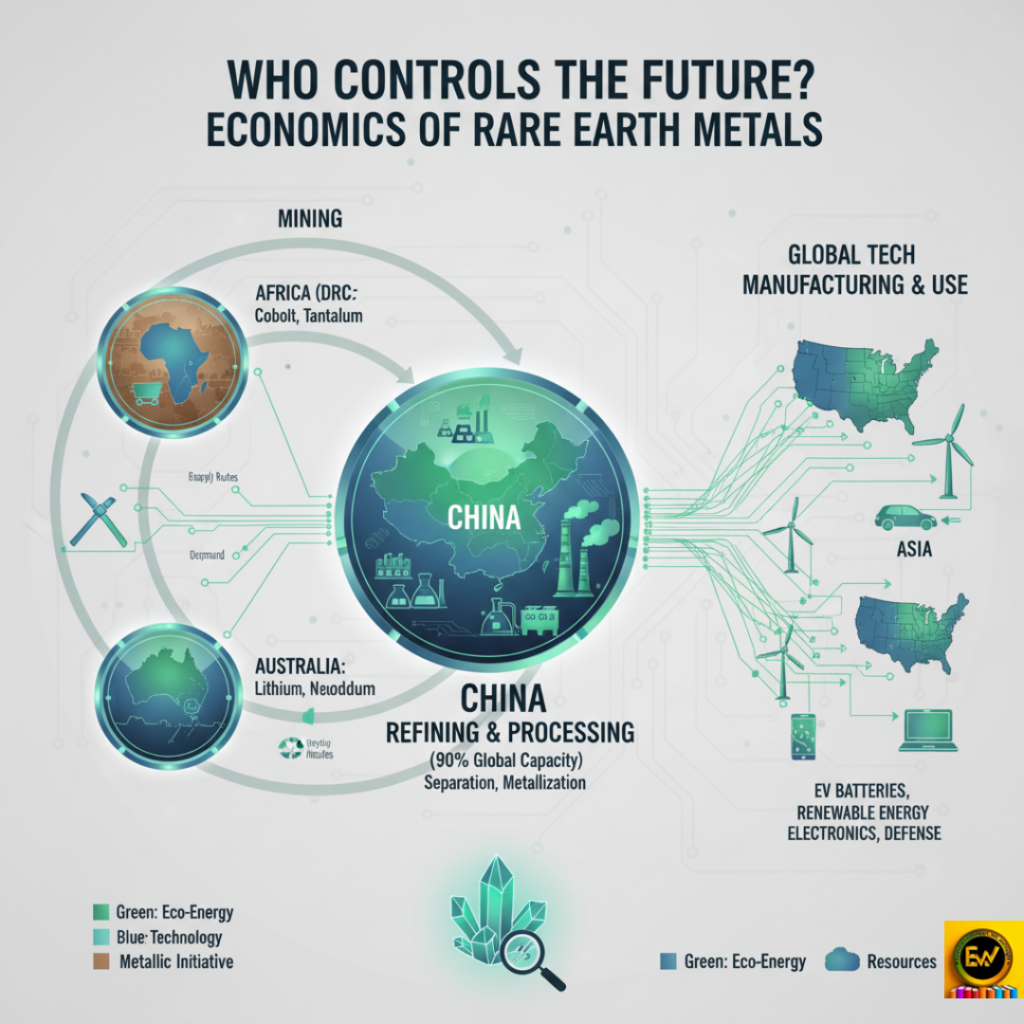
Economics of Rare Earth Metals
Rare earth elements and critical minerals are vital for clean energy and technology. They form…
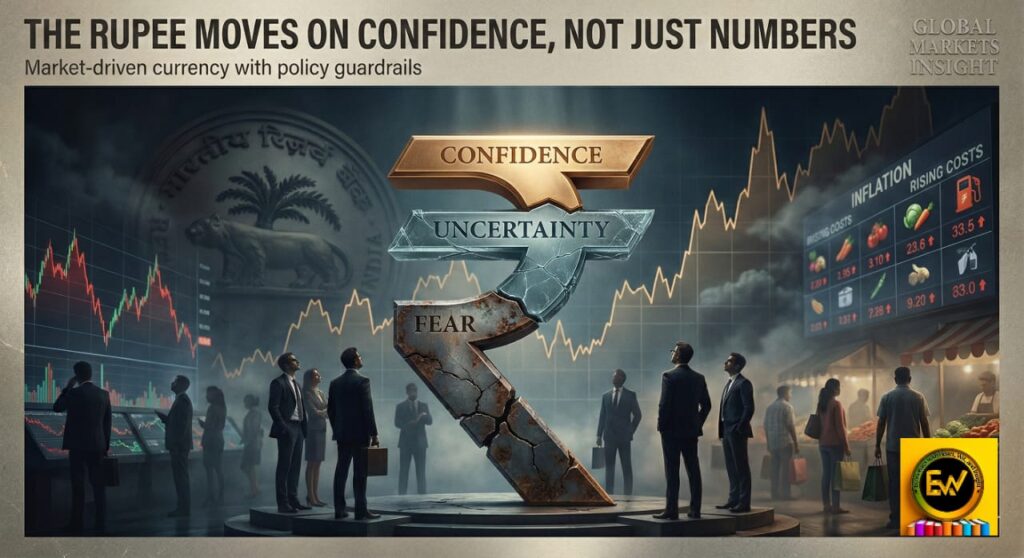
Indian Rupee Depreciation Against the US Dollar
Introduction In recent years, the Indian Rupee has undergone significant depreciation against the US Dollar,…


-
-
-
-
-
-
-
-
-
-
-
-
-
-
-
-
-
-
-
-
-
-
-
-
-
-
-
-
-
-
-
-
-
-
-
-
-
-
-
-
-
-
-
-
-
-
-
Show CommentsCan you be more specific about the content of your article? After reading it, I still have some doubts. Hope you can help me.
I don’t think the title of your article matches the content lol. Just kidding, mainly because I had some doubts after reading the article.
Thanks for sharing. I read many of your blog posts, cool, your blog is very good.
Your point of view caught my eye and was very interesting. Thanks. I have a question for you. https://accounts.binance.com/ph/register?ref=IU36GZC4
Thanks for sharing. I read many of your blog posts, cool, your blog is very good.
Can you be more specific about the content of your article? After reading it, I still have some doubts. Hope you can help me.
Thanks for sharing. I read many of your blog posts, cool, your blog is very good. https://www.binance.info/fr-AF/register?ref=JHQQKNKN
I don’t think the title of your article matches the content lol. Just kidding, mainly because I had some doubts after reading the article. https://www.binance.info/hu/register?ref=IQY5TET4
Can you be more specific about the content of your article? After reading it, I still have some doubts. Hope you can help me. https://www.binance.com/register?ref=IHJUI7TF
Can you be more specific about the content of your article? After reading it, I still have some doubts. Hope you can help me.
Your article helped me a lot, is there any more related content? Thanks!
Your point of view caught my eye and was very interesting. Thanks. I have a question for you.
Your article helped me a lot, is there any more related content? Thanks!
Thank you for your sharing. I am worried that I lack creative ideas. It is your article that makes me full of hope. Thank you. But, I have a question, can you help me?
Thanks for sharing. I read many of your blog posts, cool, your blog is very good.
Your point of view caught my eye and was very interesting. Thanks. I have a question for you.
Thank you for your sharing. I am worried that I lack creative ideas. It is your article that makes me full of hope. Thank you. But, I have a question, can you help me?
Thanks for sharing. I read many of your blog posts, cool, your blog is very good. https://www.binance.info/register?ref=JW3W4Y3A
I don’t think the title of your article matches the content lol. Just kidding, mainly because I had some doubts after reading the article. https://www.binance.info/register?ref=IXBIAFVY
Thank you for your sharing. I am worried that I lack creative ideas. It is your article that makes me full of hope. Thank you. But, I have a question, can you help me? https://accounts.binance.info/register-person?ref=IHJUI7TF
Thanks for sharing. I read many of your blog posts, cool, your blog is very good.
Thanks for sharing. I read many of your blog posts, cool, your blog is very good.
Thanks for sharing. I read many of your blog posts, cool, your blog is very good. https://www.binance.com/register?ref=IXBIAFVY
I don’t think the title of your article matches the content lol. Just kidding, mainly because I had some doubts after reading the article. https://accounts.binance.com/tr/register?ref=MST5ZREF
I don’t think the title of your article matches the content lol. Just kidding, mainly because I had some doubts after reading the article. https://www.binance.info/bn/register-person?ref=WTOZ531Y
Thanks for sharing. I read many of your blog posts, cool, your blog is very good.
Your article helped me a lot, is there any more related content? Thanks! https://www.binance.info/register?ref=JW3W4Y3A
Your article helped me a lot, is there any more related content? Thanks!
Can you be more specific about the content of your article? After reading it, I still have some doubts. Hope you can help me.
Your point of view caught my eye and was very interesting. Thanks. I have a question for you.
I don’t think the title of your article matches the content lol. Just kidding, mainly because I had some doubts after reading the article.
Your article helped me a lot, is there any more related content? Thanks!
Thanks for sharing. I read many of your blog posts, cool, your blog is very good. https://www.binance.com/futures/ref?code=QCGZMHR6
Your point of view caught my eye and was very interesting. Thanks. I have a question for you. https://accounts.binance.bh/register/person?ref=IHJUI7TF
Your point of view caught my eye and was very interesting. Thanks. I have a question for you.
Reading your article helped me a lot and I agree with you. But I still have some doubts, can you clarify for me? I’ll keep an eye out for your answers.
Your point of view caught my eye and was very interesting. Thanks. I have a question for you.
Your point of view caught my eye and was very interesting. Thanks. I have a question for you.
Can you be more specific about the content of your article? After reading it, I still have some doubts. Hope you can help me.
Can you be more specific about the content of your article? After reading it, I still have some doubts. Hope you can help me.
Thanks for sharing. I read many of your blog posts, cool, your blog is very good. https://accounts.binance.com/ro/register-person?ref=HX1JLA6Z
Thank you for your sharing. I am worried that I lack creative ideas. It is your article that makes me full of hope. Thank you. But, I have a question, can you help me?
Thank you for your sharing. I am worried that I lack creative ideas. It is your article that makes me full of hope. Thank you. But, I have a question, can you help me?
Can you be more specific about the content of your article? After reading it, I still have some doubts. Hope you can help me.
Your point of view caught my eye and was very interesting. Thanks. I have a question for you. Registrera dig
Thank you for your sharing. I am worried that I lack creative ideas. It is your article that makes me full of hope. Thank you. But, I have a question, can you help me?
I don’t think the title of your article matches the content lol. Just kidding, mainly because I had some doubts after reading the article. binance “oppna konto